Propeller Guard Information Center

Propeller Injury Protection /
Propeller Injury Avoidance Devices
and Virtual Propeller Guards

About Us

Boat Propeller guards / prop guards, boat propeller guard technical reports and patents, propeller injury cases, propeller strike accidents, propeller injuries, propeller accidents, people injured by propellers, propeller injuries, propeller guard manufacturers, manatee propeller issues, marine propeller guard research and the use of sensors to detect people near the propeller (Virtual Propeller Guards) are covered here. We hope this information will reduce the number and severity of propeller injuries by providing manufacturers, regulators, the U.S. Coast Guard, engineers and inventors with easy access to propeller safety information.

This is a Polson Enterprises web site.

If you become aware of any propeller guards, technical papers, news, reports of a propeller accident, cases, events not listed on this site, broken links, or have any comments about it, please contact us.

We also provide new product development services to companies developing propeller injury protection devices and information support to legal professionals working on propeller injury cases. If you should need either of these services, please see our Polson Enterprises web site for additional information, or contact us.

  Propeller Trial - a very interesting propeller case is being tried by jury right now in Flordia. We cover the numbers behind the case and provide links to indepth coverage on our Decker Propeller Trial by the Numbers Page.

Our friends at SPIN shared a nice article with us about the Decker v. OMC trial.

We are still seeking input on on the rough draft of a major report we just completed on houseboat propeller safety. Please help help us make this report, Response to Withdrawal of U.S. Coast Guard Proposed Propeller Safety Regulations for Houseboats, as accurate as possible.

If you would like to help in our efforts to reduce propeller injuries, we have posted several opportunities on our How Can I Help? page.

The Propeller Guard Information Center

Propeller Guard Manufacturers

Photographs of Other Propeller Guards

Other Propeller Injury Avoidance Devices on the Market

  • ACT Pump Jet Applied Combustion Tech Marine Propulsion Division Pump Jet of Orlando FL

  • Alert2 man overboard alarm from Emerald Marine Products primarily for commercial marine use

  • Autotether wireless lanyard

  • CAST Wireless Lanyard from MariTech

  • Lanyard Kill Switches - Boat U.S. review of four of them.

  • LifeTag wireless Man Overboard System from Raymarine targeting commercial vessels

  • MOBI-lert crew monitoring system including a transmitter worn by everyone on board. An alarm is sounded and the vessels position is logged if someone goes overboard.

  • NorCross Marine Products Skier Alert SP when skier or tuber falls, a PFD wearable pendant signals the base station on the boat to sound an alarm to minimize time at risk in the water.

  • Premier Marine Durajet outboard pump jets

  • Wavefinder autonomous man overboard beacon from Wavemind SA of Switzerland. All Wavefinder assets and rights were purchased by Kannad (a French beacon manufacturer) in late Feb. 2008.

  • Propeller Covers & Carriers

  • PropStopper Swim ladder and Swim Gate switch from Maritech

  • QuickProtector hard case protector for drives from Germany

  • RingProp ring propeller sold as a Propeller Guard

  • Small Outboards.com Pump Jet for outboards from AFA Marine

  • Virtual Lifeline wireless lanyard from MariTech

  • Whale Protection Device

  • Several companies, such as Raymarine produce video cameras for remotely monitoring /viewing the swim deck area and swimming areas behind larger vessels from the operator's station.

Propeller Guards That Appear to No Longer Be on the Market

  • Handler - Kort nozzle propeller - was at www.handlernozzleprop.com by Port Kent Marine, Inc.
    A indepth report on the Handler is in USCG Docket 10299.

  • Hydro-Foil Propeller Guard from Cal-Neva Marine was at www.cal-nevamarine.com lost May 2006

  • Manatee Protector Device - a transom mounted skeg and prop bar-cage

  • Prop-Mate - polypropelene plastic ring with skeg guard by Prop-Mate, Inc. of Blue Jay California. Was marketed primarily to improve boat handling, not as a propeller guard safety device. The unit is described in USCG Docket 10299 comment #629

  • Propeller Safety Shroud from CJD, Inc. is described in USCG Docket 10299 comment #2024 (PDF pages 24-32).

  • Prop-Pal - steel cage by J&W Marine Products this propeller guard appears to no longer be on the market May 2006.

  • Prop-Skeg Cage/Sled by GMG Of Naples, Inc.

  • Rock 'N' Reef Boat Motor Guard was at http://www.rocknreef.net lost May 2006 this propeller guard was distributed by Snow Creek Manufacturing of Black River Falls WI

  • Safe-Guard - cage type by Propeller-Safe-Guard, Inc.

  • Thrust Enhancer - propeller guard similar to Prop-Buddy, but with a center wheel of hydrofoils on a smaller ring

  • Unified Marine - propeller guard possibly from seasense.com?

  • Valley Machine And Design - Turbo Prop Guard - ring guard type propeller guard

Propeller Safety Advocates, Sites of the Injured, & Related Sites

Other Links Related to Propeller Safety

College Design Projects in Propeller Injury Avoidance Devices

Most college students in engineering and design take one or more design project classes in which they work individually or as teams to develop solutions to problems. We are trying to tap this resource and encourage them to consider selecting projects related to propeller safety to help increase the body of knowledge available to industry and boaters. In addition to those in engineering and design, we also welcome those from all fields and encourage them to consider projects in this area for their senior design, capstone, and similar design classes. We are currently working on a separate website specifically designed to help recruit these students.

Meanwhile, a big thank you to the engineering and design students who have already done work in this area. They are listed below along with links to their projects when possible. If anyone is aware of any more completed or ongoing projects in this area, please contact us.

  • Manatee Guard. Douglas Harris Cameron. Engineering Design Projects Fall 1999. Hope College.
    A mechanical guard to protect manatees from propellers.

  • "Designing an Intelligent Propeller Safety System" by Bram van der Vlist of Eindhoven University of Technology. October 2005. Includes a literature review of ways to detect the presence of a human body, a survey of potential users, graphics illustrating the ways people come in contact with a propeller, and a system utilizing a wearable "tag" to detect if a person is in the water, how far they are from the propeller, and take appropriate action, as well as a discussion of how the system should "look and feel". We are proud to have participated in this student project.

We also strongly encourage Masters and Doctoral students looking for thesis and dissertation topics to contact us and discuss some of the possibilities available in their specific field of interest, as well as those looking for topics for scientific papers.

Potentially Useful Legal References

These are in addition to those listed on the Reference Page of our Virtual Propeller Guard presentation.

"The Federal Boat Safety Act of 1971 and Propeller Strike Injuries: an Unexpected Exercise in Federal Preemption". Trail Lawyers Section of the Florida Bar Newsletter. The Advocate. August 2000. This lengthy paper focuses on the now gone defense of preemption, but many other elements of it are still relevant.

Decision of Interest; Southern District; Expert Witness Failed to Attempt to Reconstruct Accident or Test His Own Theories of Design Safety. New York Law Journal. Case Digest. 22 July 2004.
A very lengthy discussion of "Roane v. Greenwich Swim Committee" a case involving propeller injuries to a swimmer during a distance swimming event and his subsequent rescue. Stephen Roane was a contestant in the Greenwich Point One Mile Swim held in Long Island Sound near Greenwich CT on 8 July 2000. The event began near Tods Point. When Roane began having problems, he swam to a buoy and signaled for help. He was picked up by a kayak which then tried to transfer him to a 27 foot twin engine Tiara 2700 named Sea Breeze. The boat was powered by twin "Mercury inboard/outboard engines or sterndrives". The power boat was having some technical difficulties with the drives and while attempting to board the boat over the swim platform suffering from his own fatigue, Roane was drawn under the boat, struck by the boat and in a "great amount of pain". Someone jumped in to help him and found Roane's swim trunks were caught in the port propeller. They used a knife to cut him free and he was then taken to shore on surfboards and to Stamford Hospital. This paper goes on to explain the legal aspects of the case.

Sprietsma v. Mercury Marine: Allowing State Regulation of Boat Engine Manufacturers Through Product Liability Lawsuits. Student Article by Richard Cutshall. Loyola Consumer Law Review 2003 (Vol. 15) Page 331. This is one of the first law journal articles to address the impact of the Sprietsma decision.

Sprietsma v. Mercury Marine: The Supreme Court Misses the Boat on Maritime Preemption. Joshua S. Force. 27 Tulane Maritime Law Journal (Summer 2003) Page 389. Another early law journal article on the Sprietsma decision.

Motorboat Propeller Injury Accidents
Stephen R. Bolden
American Jurisprudence Model Trials - Vol 41 pgs. 161-348
Published by Lawyers Co-operative Publishing Company in 1990
Library of Congress card catalog number 64-56647

We feel this is a "MUST READ" for everybody in the industry who may be involved in the trial process now that pre-emption is dead. Mr. Bolden won a propeller guard case many years ago, wrote a book on the process, then lost the appeal. It provides almost 200 pages of information on how to prepare for a trial in this area. It provides a "cook book" approach for every step in the preparation and trial. Now that pre-emption is gone, both sides will be using this book, so you better be prepared for it. It is available in most major law libraries.

Propellers Turning Up Lawsuits. Trailer Boats. Feb. 1994.
A brief review of several propeller injury lawsuits.

ALR Annotations

The American Legal Reporter (ALR) has published some excellent summaries (annotations) of certain areas of boating. They begin with a specific case and then extensively cover prior litigation in that general area. As you look up these references be sure to look in the back of the books and examine the "Supplements" for more current information of these annotations. They are available in most major law libraries. Some of those with propeller injury implications are:

  • Liability of owner or operator of powered pleasure boat for injuries to swimmer or bather struck by boat. 98 ALR3d pgs. 1121-1135.
  • Liability for injuries to or death of water skiers. 8 ALR3d pgs. 665-674.
  • Products liability, sufficiency of evidence to support product misuse defense in actions concerning automobiles, boats, aircraft, and other vehicles. 63 ALR3d pgs. 1-94. In this annotation, the specific case happens to be a boat.
  • Products liability: liability of manufacturer or seller for injury or death caused by defect in boat or its parts, supplies, or equipment. 1ALR4d pgs. 394-430.
  • Should "State of the Art" Safety Be A Defense Against Liability? James W. Boyd and Daniel E. Ingberman. Oct 1995. Resources for the Future (RFF) Discussion Paper 96-01.

    For additional legal references, see the legal cases reference section of our Virtual Propeller Guard presentation and other areas of this page.

    What will it take to get the industry actively exploring alternatives?

    Note - This section was written before the Sprietsma case was overturned in the U.S. Supreme Court

    Currently no driving forces are pushing the industry from its status quo. Perhaps government regulations will be the force as it was with emissions?

    Many people with rare diseases wait a pray for a celebrity or major public figure to contract the disease and become a "poster boy" for it. As Christopher Reeves did for spinal injuries. If a well known person or their child was injured by a propeller and their family took up the cause and led the crusade, this field might change as well. Anyone who thinks otherwise might want to recall what Sarah Brady did for Gun Control. The Brady Campaign web site recounts several of their accomplishments.

    We suspect that in recent years, the industry has spent far more time and money in defending the absence of propeller guards in the court system, than in trying to solve the problem. Manufacturers have been hiding being Federal Preemption (Federal Law does not require them, state law cannot contradict federal law, thus those injured cannot successfully sue manufacturers in a state court for the absence of propeller guards because they were not required by federal law) per the Federal Boating Safety Act of 1971.

    The Federal Preemption provides incentive to prevent development in this area. Manufacturers are afraid to bring forth new propeller guard designs as they may then be required by the federal government, thus loosing the preemption and their automatic court protection. As it stands right now, they have no reason to work on propeller guards and an incentive not to. If they develop a successful design and it is later required by federal law, they could then be sued when someone is injured by it. Plus they might be sued by owners of older products for not calling and retrofitting them or for not bringing out the new design earlier.

    A loss in Sprietsma v. Mercury Marine (deciding on preemption) now before the U.S. Supreme Court would certainly change the level of attention this issue receives by the industry.

    Early History of Propeller Guards

    Information in the first paragraph below comes from Prop Guards and Alternative Propulsion. Charlotte Harbor Magazine. Jan. 2003.

    The first patent for a ring-cage prop guard design was issued in 1938 to J. R. Benson. Its main purpose was to protect the propeller and lower gear case from impacts with rocks and other debris. Additional ring-type guards came on the scene in 1943, and by 1964, eighteen designs had been patented and placed on the market. They included mesh cages, forked, and semi-ducted styles.

    Note - the history above also appears a few other places online. The 1938 Benson patent they mention, but do not supply the patent number for, is probably U.S. Patent 2,135,162 awarded to J.R. Benson 1 Nov. 1938. We have noticed a few patents pre-dating the Benson patent, including U.S. Patent 1,620,129 Propeller Guard issued to G. Peterson 8 Mar 1927 and U.S. Patent 662,522 Propeller for Boats awarded to S.H. Butterworth 27 Nov. 1900. The second being specifically targeted at canal boats to reduce shore erosion, but also mentions protecting the boat propeller from driftwood.

    About 1960 - 1962 several propeller patents also started mentioning how they could protect humans, swimmers and skin divers from coming in contact with the propeller.

    Today, things that "look like" propeller guards seem more focused in their application. They tend to target one of several functions such as providing protection to the propeller, keeping weeds out of the propeller, keeping fishing line from the propeller or protecting people.

    Databases for Other Types of Accidents

    The U.S. Coast Guard collects recreational boating accident data, maintains the database, and creates an annual report. We (Polson Enterprises) collect media coverage of propeller accidents and present the reports as a blog. Similar types of accident data are collected for many other activities by other groups. We (the boating industry) could study some of these other systems and apply those concepts and presentation methods that seem best applicable to our situation to improve propeller accident data AND its presentation. A few other systems that have caught our eye as particularly interesting are listed below.

    SPIN - Stop Propeller Injuries Now - a Propeller Safety Advocacy Group

    Per their web site, "SPIN actively promotes boating safety issues, specifically the need to protect the public from accidents and fatalities from the exposed propeller."

    We commend them for their efforts and encourage you to visit SPIN. They have worked long and hard to provide support to survivors, inform the public, legislators and regulatory agencies and to network with victims and their families. Their work has helped keep propeller injury protection issues in front of regulators and manufacturers.

    Typical Propeller Injury Scenarios

    In terms of protecting people, people tend to encounter a rotating propeller in one of the following scenarios. Note many of these incidents occur as the second or third step of an evolving accident (Man overboard, collision, run aground, capsizing, hit rouge wave or high wake, etc).

    • They are in the water at the rear of the boat as a result of swimming or skiing and the prop is started in a forward direction.

    • They are in the water at the rear of the boat as a result of swimming or skiing and the boat/prop is backed into them, such as when backing up to a skier.

    • They are in the water at the back of the boat with the engine running and think the prop is in neutral, but it is turning and strikes them or pulls them in.

    • They fall out of a moving boat and are struck by the boat as it passes over them, they tend to fall over the side during a sharp turn or from the front of a bowrider or a pontoon boat, when the boat goes over a large wake, or fall over when the boat suddenly strikes an object.

    • A few people have been ejected in a sharp turn when their seat post broke, they go overboard, and are then struck by the propeller.

    • A few young children being held, have fallen overboard and been stuck.

    • People fall out of a moving boat and it circles around (without a driver) and runs over them, sometimes repeatedly.

    • All those in a boat are ejected (one or more people) and the boat begins to circle automatically until it runs out of gas. One of more of those in the water are struck by the propeller as the boat circles.

    • They are in the water swimming, tubing, diving, surfing or water skiing (usually in the water, not up on their skis) not seen by a boater, and are ran over and struck by a propeller.

    • They are in a collision. One boat or PWC is typically broad sided by another boat that actually runs over it with the propeller striking one or more people in/on the first boat/PWC, or an occupant of a boat being knocked under its own propeller during a collision.

    • On a few occasions, people in the water wearing PFDs / life jackets have been ran over while they were unable to dive to avoid being struck due to vest floatation.

    • Larger, slower revolving propellers (like on houseboats) have a very large field of suction and are capable of pulling in swimmers from considerable distances, even from swim platforms or ladders or floating nearby on air mattresses. This seems to most often happen when the boat begins to get underway, and the operator was unaware there were people near the propeller.

    • Some people are drowned from entanglement with a propeller. Once they are in the water (fell in, dove in, swimming, etc) their clothing, a rope, fishing line, cable or other fabric entangles them with the propeller, trapping them under water and they drown. This most commonly happens when the boat is at rest or underway very slowly. KARE11 of Minneapolis St. Paul captured an aerial view of a rescue of this type in a 12 Jun 2007 report on our accidents page.

    • On occasion propellers become caught / entrapped in cables, fishing lines, crab pot lines and other underwater hazards disabling the ability of the boat to move. While disabled the boat faces extra dangers from bad weather, nearby outcroppings of rocks, oncoming vessels, even pirates in some areas. A 27 footer sank in this condition on 12 April 2006 in Maryland. A small crayfishing boat was capsized in 3 to 5 meter seas in Australia 15 April 2006 when a crayfish pot became entangled in the prop.

    • Some people have been injured cleaning weeds or debris from their propeller, such as the 27 May 2009 Waco TX injury where a man seemingly slipped and fell into the raised outboard he was cleaning weeds from.

    • On rare occasions people on land (the shore), a pier or a floating dock/marina are stuck by a propeller when a boat actually runs over them.

    • About 2001, carbon monoxide (CO) poisoning was identified as a major risk to those who teak surf, the act of hanging onto swim platforms to body surf. Most reports calling attention to the carbon monoxide hazard of teak surfing also mention the hazard of being so close to the propeller. The 2 August 2001 U.S. Coast Guard Safety Alert advising boaters not to teak surf is an example. Although boaters are encouraged not to participate, some propeller guard devices might minimize propeller injury risk to those who do.

    • Commercial harvest divers report dive boat propellers sometimes lacerate them as well as cut their air hose (they dive on a hose). One commercial diver accident occurred when the propeller was turning, an air hose became entrapped in it and drug the diver into the propeller.

    Propeller shafts have fallen out of inboards allowing the boat to take on water (see 26 Apr 2006 media accident report from Scotland). Similarly, portions of stern drives have been ripped from the transom after hitting underwater or floating obstructions, allowing water to enter the boat. A 2003 accident reported 27 May 2006 in the media accident section tells of a propeller striking a rock, then tearing a hole in the boat which quickly sank.

    Some people are injured by a non-rotating propeller on a boat or by loose propellers. People tend to encounter non-rotating propellers in the following scenarios.

    • They cut their feet on an installed propeller when it is not turning. They may have been swimming or skiing and climb on the drive to enter the boat.
    • They "walk into" the prop when the boat is on a trailer
    • Children may play with a prop when the boat is on the trailer
    • They are injured when handling a loose propeller, especially high performance or racing propellers with sharper, thinner blades.

    Some have drowned due to non-rotating propellers
    • They were trying to free the propeller of an entangled rope, anchor line, cable, line or sea grass and drowned
    • The prop was temporarily disabled due to entanglement (see above) and as a result the boat could not avoid being pulled over the dam, get out of the storm, reach land, etc.
    • The prop was disabled due to a spun prop (rubber insert failed so it just spins but the prop does not spin). Similar problems to entanglement
    • Being ejected overboard or already in the water and get their clothing caught on the propeller.

    Types of Propeller Guards and Related Devices

    Most devices suggesting they offer increased levels of protection over conventional inboard, outboard and stern drives fall into five broad categories: Marine Propulsion Designs, Cages / Screens, Shrouds / Rings, Deflectors and Miscellaneous Accessories. Several devices or approaches in each category are listed below.

    Marine Propulsion Designs / Drive Types

    • Inboard Water Jets (water intake in bottom of hull, nozzle is behind transom)
    • Centrifugal Water Jet Outboard (everything is behind the transom, intake is part of the drive)
    • Axial Pump Jets (ACT Marine)
    • Tunnel Drives
    • Ducted Drives
    • Kort Nozzles
    • Rim Driven Drives (like Brunvoll and Norpropeller's Rim Driven Thruster RDT)
    • Partially submerged water jet (Hydro-Air Drive)
    • Riverboat paddle wheel drives, stern wheeler
    • Hovercraft
    • Airboat (big fan on the back)
    • Electric Drives - U.S Patent 6,676,460 senses people in the water and brakes the drive
    • Hazelton Propulsion - most often used on submersibles. Like a ring of variable pitch blades captured in a carrier going around the circumference of a submarine. Can be adapted to boats by extending round "pods". U.S. Patent 3,805,723 for example.
    • Oars / Paddles
    • Exotic Drive Types not currently on the market
      • Pursuit Dynamics steam drive
      • Hydrodynamic Flushing Propulsion from Tyvik of Norway- nozzles shoot water horizontally perpendicular to the bow to reduce pressure on the front of displacement boats (could be a houseboat) and pressure on the back of the boat pushes it forward. Vestfold University students are working with Tyvik.
      • MagnetoHydroDynamic Propulsion (MHD) - not currently practical
      • Fishlike propulsion (MIT Robo Tuna)
      • Flapper drives (a flat sheet is "flapped" in vertical or horizontal plane)
      • Track drives (something looking like a snowmobile track puts its tread in the water)
      • Bowthruster Propulsion - something looking like a bowthruster sucks water all the way through the boat and pushes it out the stern
      • Rocket propulsion
      • Boeing low signature propulsion - expands and compresses a volume to expel water U.S. Pat. 6,860,770 and others.
    Cages / Screens
    • Conventional prop guard cages / screens
    • Cages that swing up out of the water at high speed to minimize performance and handling impacts
    • Retractable cages
    Shrouds / Rings
    • An extended ring or duct is installed around a prop on an existing drive
    Deflectors
    • Deflectors in front of drive or propeller, including drive skegs
    • Deflectors beside the propeller
    • Deflectors below the propeller
    • Deflectors behind the propeller
    Miscellaneous Accessories
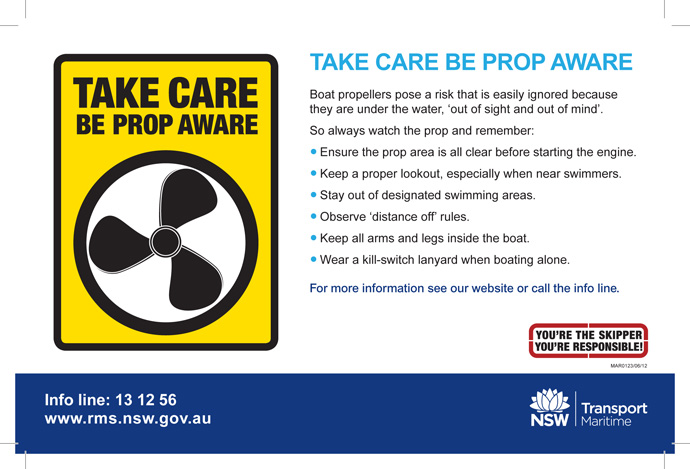
    • Propeller Risk decals - decals describing the risk involved with propellers are prominently placed.
    • Detect driver not at the helm and possibly overboard
      • Traditional lanyard
      • Wireless lanyard (CAST from MariTech)
      • Detect driver sitting down or present by weight in seat of use of infrared detectors
    • Ring around the propeller (RingProp)
    • Folding Propeller (sail drive type prop could be folded flat when people detected nearby)
    • Mirrors near rear of boat viewable by operator (used by houseboats)
    • Video camera near rear of boat and display near operator (used by houseboats)
    • "Person in the Water" flags
    • Diver flags
    • Start up time delay - when starting the boat, an alarm sounds, then the boat starts several seconds later
    • Swim ladder / Swim Gate interlock switch - if swimmers lower the ladder or open a gate to get into the water, their boat will not start until the ladder is raised / gate is shut. (MariTech)
    • Sensors detect people going into the water (Turtle wrist watches or Maritech Virtual Lifeline)
    • Electronic pendants worn like wrist watches, or tags that can be detected when someone is near the propeller - these have been proposed, but not currently on the market.
    • Forward looking Sonar - EchoPilot
    • The use of "soft" propellers and energy absorbing materials has been proposed, but no appropriate materials have been identified.
    • The use of seat belts has been proposed, but creates problems with capsized boats.
    • Virtual Propeller Guards - sense people in the water near the propeller - Patent 6,354,892 (Brunswick infrared), 3,805,723 (U.S. Government uses "feelers" on a Hazelton prop on a submersible) and 6,676,460 are examples.
    • In late June 2005 I had the idea of fouling the prop when people were detected near it and the prop was being powered or about to be powered. Releasing a net, mesh, web, sheet, rope, chain, twine, string, fishing line, chemical compound or other materials that would cling to or wind up around the prop to slow the progress of the boat, and blunt the sharp edges of the prop before people were struck. More info is in the Fouling the Propeller on Purpose section. This approach could be one of many possible actions considered by a system making decisions based on readings from sensors detecting people in the water (and perhaps their distance and direction from the prop) and sensors detecting boat variables (engine speed, boat speed, in gear forward / reverse, neutral, etc)

    • Inject air into the water from electric powered boats and sailboats to create noise (like power boats create noise) so swimmers and marine life can detect the presence of and direction of oncoming "previously quiet" boats. This system might reduce propeller strikes from electric boats as they become more popular. See U.S. Patent 6,976,891 issued 20 Dec 2005.

    Interventions Not Involving Devices

    Approaches other than the use of devices have been advanced as possible solutions or at least partial solutions to reducing propeller injuries. For example, the concept of educating boaters in safe operation of boats was advanced by the U.S. Coast Guard in their Preventing Propeller and Boat Strike Accidents. U.S. Coast Guard Boating Safety Circular. June 1994. Pgs 1-2. Additional interventions that have been advanced by others are listed below.

    • Propeller Danger warning signs, warning decals, warning placards placed on boats, especially near the drives and boarding ladders pointing out the hazards of open propellers, their location, and how to avoid them when rotating.
    • Boater Safety Education - general boating safety education (including mandatory boater safety education) has been advanced in part as a means of preventing accidents such as man overboard, collisions, and others that often place people in the water that are then hit by propellers.
    • Propeller Danger Education - the use of flyers (such as the recent Coast Guard flyer on Propeller Dangers) and other vehicles to convey the danger of propellers to boaters and keep it in their minds.
    • Educating young children in school about the dangers of propellers with the intent they will convey that knowledge to their parents as well (SPIN tried it a few times in 2006)
    • Partial or Total bans on the use of alcohol on board. This approach is advanced as helping prevent man overboard situations that lead to propeller strikes, reducing the number poor judgement decisions that lead to propeller accidents, and reducing the number of other accidents that lead to propeller accidents.
    • Focusing education strongly on sectors thought to be at larger risk such as PWCs, towed sports, rental boats, rental houseboats, youth operators, divers, etc.
    • Vessel design - placing propellers in places less likely to be exposed to people in the water, placing boarding ladders in places less likely to expose people to propeller risk, higher side rails, designs that force people out of bowrider bows when underway, etc
    • A State Fair type booth showing propellers chew up pumpkins or some other surrogate for people in a live demonstration similar the seat belt simulator used by those encouraging the use of seat belts often seen at large public gatherings. People participate by rolling the pumpkin down a chute to the water, it is drawn in by the stationary propeller and struck. The same process could be done virtually online in a educational setting, or just show an actual videotape of in on YouTube or a similar site. The demo could be combined with materials showing the many benefits of boating, but still bring attention to the need to be aware of the danger of propellers.

    Additional Uses, Functions and Benefits of Propeller Guards

    Most people think of propeller guards as a means to protect people from being injured by boat propellers. However, the earliest uses protected ship propellers from being damaged by debris (floating, partial submerged, or totally submerged), rocks, shoals and other shallow water hazards. In addition to these uses, some early recreational boat propeller guards also protected propellers from impacting submerged trees, submerged tree stumps, running aground and weed entanglement.

    As time has progressed many other benefits have been recognized:

    • Some are specifically designed to preventing fishing lines from being entangled in the propeller. Others provide at least some level of protection from fouling with fishing lines or lobster lines.
    • Propeller guards (and or water jets / pump jets) have been advocated to reduce injuries to several forms of marine life including manatees, whales, dolphins, manta rays, sharks, penguins, otters, and sea turtles.
    • Some types reduce marine plant life destruction, including sea grass.
    • Some types of propeller guards reduce wake, resulting in less shore erosion.
    • Some types of propeller guards reduce turbulence and shear that can be harmful to small marine life (See 20 Jan 05 "Motorboats and Ecology" article in "The Providence Journal".
    • Some types of propeller guards reduce channel erosion (erosion of shallow bottom)
    • Some ring guards and deflectors bring the bow of the boat down, improving visibility for the driver.
    • Some ring guards increase thrust.
    • Some rings, cages and other guards reduce propeller theft.
    • Many propeller guards increase propeller life by reducing impacts with debris and shallow bottoms (props last longer, costs less to keep the boat operating). Prop replacement costs can be significant.
    • Increase resale value of the boat.
    • Reduce insurance costs. (discount for having a guard)

    • A device proposed by Boeing also reduces the "acoustic signature" of the drive making it harder for others to find the boat (military applications).

    Objections Raised to Propeller Guards and Related Accessories

    Many objections have been raised to the use of conventional cage / screen and ring type propeller guards as well as some of the related accessories said to help prevent or reduce propeller injuries Some of these objections have been raised by groups opposing the use propeller guards. These objections may or may not have merit depending upon a specific vessel, the specific guard, what the boat is used for, and its operating environment. Objections raised include:

    • Restrict Performance
      • Lower top speed
      • Decrease acceleration
      • Increase drag
      • Reduce reverse thrust
    • Disturb flow in front to the propeller, decreasing its efficiency
    • Guards themselves entrap people, injuries become more severe
    • Increase zone of danger (Guards increase cross sectional area for impact)
    • Create unstable handling conditions
    • Reduced maneuverability at low speeds
    • Reduced maneuverability at high speeds
    • Poor handling
    • Durability problems
    • Increased steering loads
    • Poor steering in reverse
    • Increase fuel consumption
    • Not as dependable as a bare propeller
    • Not as efficient as a bare propeller (takes more horsepower for same performance)
    • Guard cost, installation, and operational cost add to cost of ownership of a boat
    • Increased maintenance
    • Not aesthetically pleasing - detract from "appearance" of the boat
    • Detract from the appearance of the drive
    • Deeper draft (ducts stick down lower than the prop itself)
    • More surface area exposed to corrosion and marine slime problems
    • Some may be noisy
    • Are too expensive
    • Cavitation problems
    • Ventilation problems
    • Guards interfere with use of "ear muffs" (clips to run fresh water thru the drive after use)
    • Guards interfere with access to the drive or propeller for maintenance
    • Easily foul with floating weeds / plant growth / seaweeds, especially in reverse
    • Easily foul with debris
    • Foul with ski ropes
    • Foul with fishing nets
    • Fouling could result in stranding of the vessel
    • Although guards may provide some level of protection from fouling with fishing lines or lobster lines, once a prop does becomes fouled with a line, the line is more difficult to remove with the guard in place
    • The cage itself may become fouled with fishing lines or lobster lines
    • "Off throttle" steering performance
    • Increased stopping times and increased stopping distances
    • Increased turning times
    • When someone falls out they can be injured falling into the direct stream of water from water jets
    • Engine emissions are increased due to the additional drag (engine has to work harder and creates more emissions)
    • Prop guards added in the field may require purchase of a new propeller to keep the engine RPM in proper range (it may go too low) or to improve efficiency.
    • Prop guards may decrease WOT (Wide Open Throttle) RPM below allowable limits and void the engine warranty.
    • Commercial boats, fishing charters, and others running a fixed route may require additional routine maintenance and overhauls because the engine must run longer to cover the same distance (lower top speeds take longer to run the route, get out to the fish, etc).
    • Why worry about protecting from a propeller strike if it occurs after they have already been struck by the lower unit (gear case, skeg, etc) at high speed before the propeller strike occurs.
    • Are not commercially available without the above problems
    • Many people just respond, "They are not technically feasible".
    • Some sensor approaches require the person to wear a sensor (it only protects people with something on them)
    • Does not protect people from all the scenarios listed in the scenario section above
    • Just like motorcycle helmets, some people may want freedom of choice (no helmet and no prop guard)

    • Structural integrity of guards - Some guards may vibrate off, crack or break under higher horsepower loads (larger motors) or after periods of running at full speed. When they fail, they may also damage the propeller or the drive itself, including the internal gears/shafts. Wires of cage type guards have broken welds in the past. They may cause severe vibrations when wires, rods, or welds break.

    • Device may require modification, adjustment or "tuning" for the specific drive, boat and boating activity. This modification, adjustment or "tuning" may be difficult and doing it improperly may make the craft unsafe.

    • If the device reduces performance (speed, acceleration, fuel consumption) of the vessel and is installed by the boat builder, the builder may install a larger engine to get the performance of the boat back near where it was without the device. If the boat owner wishes to eliminate the reduction in performance, the owner may remove the device at which time the boat may become overpowered and unsafe. Plus installation of the larger engine itself mentioned earlier results in increased weight and drag on the vessel. In some situations this could result in the need for a trailer with additional capacity and/or a larger tow vehicle.

    • Presence of safety devices may give boat operators or those in the water a false sense of security and result in them exposing themselves to additional dangers/risks of being struck they would not have without the device (such as operating the drive in proximity to swimmers). These operations may result in injuries.

    • Marine drives come in many types (outboard, inboard, stern drives, water jets, etc) in several different horsepower classes. They are used on dozens of types of recreational boats (bass boats, runabouts, saltwater fishing boats, pontoon boats, deckboats, houseboats, ski boats, wakeboard boat, etc) and used for dozens of applications (fishing, skiing, diving, wake boarding, high performance, river running, etc). No one single propeller guard method / design covers more than a few elements of the large matrix of drive type X horsepower X boat type X application. Plus those building the drive may not know what type of boat it goes in and those selling the boat may not know what it will be used for. This could make it hard for manufacturers to select the proper guard approach for your drive and boat. A 2002 U.S. Coast Guard article put it like this, " There is currently no one size fits all solution..."

      or as a U.S. Coast Guard Boating Safety Circular 81 put it "None of the devices has the high degree of practicality in a wide range of operating environments (trash, weeds, shallow water, damage tolerance, etc.) as that established by an unguarded propeller. For planing vessels, the study concluded that some improvement in low-speed human protection can be achieved at the expense of decreased performance, decreased high-speed protection and some decrease in practicality. The cost benefit ratio for using the tested devices on planing vessels is sensitive to both vessel type and operating environment.

    • We found an incident of a surf rescue boat propeller guard fouling several times on jellyfish during a major jellyfish outbreak in New Zealand. They had to actually take the guard off to operate.

    • Propellers are well known for entangling with ropes, anchors, fishing lines, nets, etc. Some propeller guards provide some protection against this entanglement (entanglements occur less frequently), but when/if they do occur the entanglements are more severe and require more time/effort and possible removal of the guard to remove.

    • Limited selection of guards. Some devices are patented and demand for guards (sales) is limited. This results in a relatively small set of off the shelf guards for a specific boat and situation.

    Comments on the List Above:

    • The real or perceived animosity to the use of guards by drive manufacturers and boat builders has at one time or another been attributed by some to:

      • Their fear of losing the lucrative business of selling propellers (if guards keep propellers from being "dinged" or damaged, they will sell far fewer propellers).

      • They are more concerned about the bottom line than the safety of their customers.

      • They would have to eat the statements they have said for so many years that guards were no good, did not exist, etc.

      • They are trying to pass responsibility down the chain:

        • Drive manufacturers say one type of guard wont work in all applications and we dont know what kind of boat this drive is going to wind up on, so we cant put a guard on it.(thats a bit difficult to believe when it comes from Brunswick that is putting it own drives on its own boats)

        • Boat Builders say we dont know how or where the customer is going to use the boat so we dont know if it needs a guard or not or what type of guard it needs.

        • Boat Dealers say they dont have the research capabilities to figure out what type of guard you need, they dont want to accept responsibility for it, put a guard on yourself if you want one, but it may violate your warranty.

      • Prior to December 2002, Federal Pre-emption was seen as a reason not to use guards (prior to the U.S. Supreme Court ruling on Sprietsma v. Mercury Marine, lower courts had said since the U.S. Coast Guard did not require guards, states could not require guards.) This was actually an incentive to do nothing. It was the only safe square on the checkerboard for them. (See reasons below)

        • If they started to use guards, it would signal their previous products were dangerous. (not good for them in pending or future court cases)

        • If they started using them and chose/elected or were forced to retrofit units in the field, who would bear the huge costs for retrofit/ recall (drive manufacturer, boat builder, dealer, owner)? None want to bear the cost or any portion of it.

        • Even with the use of guards, a few people will still be hurt now and then. Companies would still be sued by those struck by guards, injured installing them, injured by guards installed improperly, etc.

      • Now in a Post 2002 world, they may be trying to hang on to their old ways for as long as possible.

      • They may be hanging on hoping for an alternative that does not make them look bad (something like the Virtual Lifeline tags from MariTech). Drive manufacturers could say these did not exist in the past so we did not make bad decisions then. Guards are still bad, but this new technology solves the problem, plus we can sell it at a good markup and our props will still get dinged up when they hit something, keeping our highly profitable aftermarket prop business intact. Its the best of both worlds.

    • Before those objecting to guards say the list of objections above is insurmountable due to its pure length alone (number of objections that have been raised), please notice that if you mentally select a type of boat, a general use for that boat, and general type of guard, many of the objections listed above vanish, or do not come into play.

    • In today's economic environment (late 2008) drive manufacturers and boat builders are fighting for their own survival in these tough economic times with a very strong downturn in sales, lack of available capital, lack of loans for potential buyers, high fuel costs, decreased home values (potential boat owners cant take out a second mortgage on their home) and other issues, propeller safety is not on the table. Companies are slashing and burning trying to keep from sinking themselves and feel they have no time to spend on issues of this nature.

    • Some say boater safety education and warnings fix the problem and no guards are needed.


        Cross Sectional Area, Impact and Water Density Issues:

    Water is much more dense than air. A person struck by an object in water suffers a much greater impact than being struck by the same object at the same speed in air. One U.S. Coast Guard report says being struck by an object in water at 1 mile per hour is equivalent to being struck by the same object in air at 29 miles per hour. A 1989 NSBAC report indicates 80 percent of "struck by boat or propeller" accidents occur above 10 miles per hour. The use of cages, guards or deflectors usually increases the cross sectional area of the drive which could strike more people.

        How to Sort Through the Existing Possibilities:

    In the past several approaches have been evaluated by the U.S. Coast Guard or independent groups. Typically they select an approach and several of the objections listed above (mostly performance, handling, efficiency variables) and rate several drive types or boats on those characteristics and produce a table similar to the Comparison Table recently produced by IntelliJet Marine, Inc (formerly Marine Jet Technology Corp.).

    The Coast Guard tends to pick a few sizes and horsepower ranges of boats and test them for variables like top speed, fuel efficiencies, handling, then rate each combination with various protection measures installed.

    The rating system can be improved by weighting the individual variables, but it becomes pretty subjective if you begin to consider broader applications.

    We are currently working on some tools to help individual boaters sort through the various propeller injury protection devices to find the best approach for their situation, plus make them aware of other things they can do to reduce the probability of propeller accidents.

    Virtual Propeller Guard Terminology Proposed by Polson Enterprises

    We have referred to this collection of technologies by various terms in the past (Stealth Prop Guards, Sensor Based Propeller Guards, Virtual Prop Guards), today April 20, 2002, we propose the media, companies involved in this area, inventors, patent lawyers, patent offices, law firms, courts, U.S. Coast Guard, researchers and others refer to this group of technologies and systems in the future as Virtual Propeller Guards. We present an "official definition" of the term below.

    Virtual Propeller Guard: A system composed of sensors, decision making capability, actuators and one or more outputs. The system detects potential collisions with objects near or soon to be near a submerged marine propeller about to be engaged or currently engaged. Objects detected may include people in the water, large marine life, floating or submerged debris and the ground. If a potential collision is detected, the system takes appropriate action(s) such as shifting to neutral, turning or braking the craft, slowing the craft, raising the drive, shutting off the engine or sounding surface or underwater alarms in a manner to prevent or minimize the severity of injuries to people in the water, people in the vessel, manatees and other large marine life, and to the propeller and drive. Sensors may scan the area to the rear of the vessel, beneath the vessel, around the vessel and in the vessel's path. Other sensors may monitor the steering system, throttle position, shifting mechanism, engine, navigational charts, GPS and the position of swim ladders. Virtual Propeller Guard can be abbreviated as VPG or plural as VPGs.

    Later comments
    • The Definition of a "Virtual Propeller Guard" might be extended to include devices predicting or anticipating an increased probability of a hazard or safety issue near the propeller. Swimming ladder switches and gate switches may logically fit inside the definition of "Virtual Propeller Guard" as they help predict an increased probability of people being near the propeller. In the end, they actually somewhat parallel to the people sensor based detection methods. Instead of detecting people and taking an appropriate action, they anticipate people may be in the danger zone and take the appropriate action.

    • The definition of a "Virtual Propeller Guard" could probably include "preventing the engaging of the propeller" and "preventing the starting of the engine" as actions a Virtual Propeller Guard system might select.

    • We may the only ones psyched up about creating a definition. If you have any comments, drop us an email.

    Dangers of Non Rotating Propellers

    Many think propellers only present danger when they are rotating. Propellers can be very dangerous even when they are not rotating, particularly stainless steel propellers as they tend to have thinner blades. High Performance and racing propellers can be even more dangerous due to their sharpness.

    A 1993 paper, A Study of Boat and Boat Propeller-Related Injuries in the United States 1991-1992, by the Center for Disease Control used reports from the National Electronic Injury Surveillance System in conjunction with reports from Florida's state wide trauma registry to estimate national propeller injury counts. The study estimated 670 people were injured during the year studied (Sept 1, 1991 thru August 31, 1992) by propellers on boats that were NOT rotating. Or with 95 percent confidence intervals that between 335 and 1,005 were injured by propellers on boat motors that were "off". An Appendix to the study presents several individual accidents as examples. They range from stepping on the propeller, sliding off the rear of the boat and landing on the propeller, entering boat from rear when it struck a wake and foot hit the propeller, foot slipped off step while entering and struck propeller, 6 year old girl learning to ride a bike rode by a boat on a trailer and grabbed the prop to balance herself and was cut, swimmer approached rear of boat and their hand hit the propeller, swimmer knocked by a wave in the propeller, slipped off back of boat and foot struck propeller, etc.

    A 7 March 2002 letter to the U.S. Coast Guard in response to an open request for comments surrounding proposed propeller guard regulations contains the testimony of a Maryland woman who was injured about 13 years earlier by a non rotating propeller. She was boarding the ladder when her right foot struck the non rotating propeller. She required 14 stitches, physical therapy, and was restricted from driving for some time.

    These accidents, combined with propeller theft, and frequent trailering of small boats has led to several new products in the area of propeller bags and covers for use when in transit on trailers, propeller carriers for carrying propellers, full drive covers, and even propeller covers to protect boat covers from being cut by the propeller. These products and more are listed in the Propeller Covers and Carriers section of our list of Propeller Injury Avoidance Devices.

    It is our understanding, that in the United Kingdom, trailered boats have to use a reinforced propeller bag or cover the propeller with a bucket when on the roads.

    Manatee Reference

    An excellent discussion of the Manatee problem, past and current is in the Feb. 2004 Smithsonian.

    Fury Over A Gentle Giant
    Smithsonian
    Feb. 2004 Pgs. 55-59.

    Boaters Demographics, How are they Boating, What Boats are in Use, etc?

    Those developing propeller guards and other protective devices need some level of understanding of the types of boats out there, what types of people are boating in them, their level of experience, and other variables surrounding the use of propeller guards and similar devices. The links below provide a basic understanding of the environment.

    Closing Note to Those Developing Propeller Injury Reduction Devices

    We wish you good luck with your efforts and would like to offer a few thoughts. We have been approached by several people who were sure their idea would solve the problem and save everybody's life, but their idea was just a few scratches on a piece of paper. It had never been tested. The proof is in the pudding. This problem has been around a long time and will still take some some very serious work to solve in some applications. Don't be making wild claims before you have but some work and effort into your device AND tested it. For as Carl Sagan, the astronomer once said, "Extraordinary Claims Require Extraordinary Evidence." Plus please remember we provide development services in this area as Polson Enterprises, and have one of the largest libraries of recreational boat propeller guard information in the world.

    Polson Enterprises Research Services
    The Boating Industry Specialists

    FEEDBACK

    If you have any comments about Virtual Propeller Guard design, see any prop guard news, or would like to contact us from additional information in this area, drop us an email.

    Mission of the Propeller Guard Information Center

    Make boating safer by:
    • Increasing awareness of propeller injuries and their severity
    • Increasing awareness of existing propeller injury avoidance devices
    • Providing online, free access to a repository of information surrounding all aspects of propeller injuries (this is particularly useful to the media and individuals in communities immediately after an accident)
    • Being a catalyst for continuous improvement of existing propeller injury avoidance devices
    • Scouting for and monitoring emerging technologies that might be useful in reducing propeller injuries.
    • Encouraging the utilization of new technologies in future propeller injury avoidance solutions
    • Encouraging the collection of more accurate propeller injury statistics
    • Encouraging the collection of more detailed information surrounding propeller injury accidents
    • Monitoring media reports citing U.S. Coast Guard propeller accident statistics to make sure they include all USCG BARD reported motor/propeller strikes and not just USCG BARD Event 1 accidents (see our statistics page) so the public is not misled.
    • Promoting academic, scientific and technical research in this field
    • Disseminating information to manufacturers of propeller injury avoidance devices
    • Encouraging networking between those advocating reducing propeller injuries
    • Encouraging manufacturers of marine drives and boats to reduce propeller injury risks
    • Utilizing the skills and connections of other propeller safety advocates when possible, allowing us to spend more time doing what we do best and them to do the same
    • Responding to USCG, NASBLA and other proposed propeller safety initiatives with detailed information to encourage and allow more fact based decisions.

    Copyright

    Copyright © 2006, © 2007, © 2008, and © 2009 Polson Enterprises. All rights reserved.

    Return to Recreational Boat Building Industry Home Page