Possible Propeller Guard / Propeller Safety Technologies
This page lists propeller guard and propeller safety technologies we listed prior to the website moving to WordPress format in June 2011. Since the move, new technologies are listed in the Blog in the technologies category.
Several technologies have come on the scene since those we listed long ago in our original presentation on Virtual Propeller Guards. These technologies may be useful in detecting people in the water near propellers and making decisions based on those findings to protect people in the water and in the boat. Some are listed below along with public disclosures of some ideas and inventions we have had in this field. We have also expanded the list to include technologies with possible applications to conventional propeller guards as well.
In general, we think much could be learned from other fields working on similar problems, including:
- Homeland Security, the U.S. Navy, and others trying to detect swimmers and divers near ships to prevent acts of terrorism.
- Tractor Power Take Off (PTO) safety efforts.
- Tractor Roll Over Protection systems (ROPS) (they try to prevent people from contacting the ground).
- Vehicle backover prevention systems.
- Vehicle video vision systems
- Swimming pool systems to detect children falling in.
- Swimming pool systems to detect swimmers in trouble.
- Use of multiple sensors to detect landmines.
- Sensor fusion (combining the results from sensing several variables to gain a better sense of what is going on).
If you have or become aware of any technologies that might be useful in reducing propeller injuries, or have any comments about this page, please contact us.
- Posted 26 January 2011 – First Alert Pool Alarm. Popular Science. December 2010. Page 73.
- Posted 20 June 2010 – Virtual Propeller Guard Detects Absence of Water
- Posted 17 June 2010. PGIC Invention – System For Automatically Detecting and Stopping Boats in the Circle of Death
- Posted 27 May 2010. Reducing Blunt Trauma from Propeller Guard Strikes
- Posted 7 December 2009 – PGIC Invention
- Posted 30 November 2009 – PGIC Two Inventions
- Posted 21 August 2009 – Self Adjusting Backup Alarms. Some have suggested the use of backup alarms on large vessels like houseboats in the past to alert people in the water the engines are about to start. Backup alarms could be automatically sounded for a few seconds before the engine is started. Objections have centered on their noise levels being disconcerting in the environment houseboats operate in. Self Adjusting Backup Alarms that adjust their output to ambient noise levels are now available from several sources, including the Smart Alarm from ECCO. This concept could be extended to pre-recorded verbal alarms (“Get Out of the Water, the Engine is About to Start”) as well. These alarms could be automatically sounded at 5 DB above the background noise level.
- Posted 21 August 2009 – Preco Electronics is making some very interesting radar backup systems for heavy duty equipment. They might be a good partner for someone trying to develop similar on water systems.
- Posted 2 February 2009 – Three PGIC Inventions
- Use of band pass filters with the infrared sensors of approximately 8 to 14 microns to eliminate false signals outside those wavelengths.
- Use of smaller zones in voting and in detecting movement between the zones (detecting an object moving from one zone to another when the boat is at rest indicates it is moving which makes it more likely to be a human). Similarly, moving from one zone to a zone different than would be expected when the boat is in motion indicates the object may be a human.
- Additional variables could be sensed/monitored to improve accuracy. Each sensor could be given a different weight based on its accuracy and the current operating conditions of the boat, environment, etc.
- Aiming one or more devices horizontally above the waterline to improve detection of the portion of people’s bodies or objects they may be floating on above the water line. Note- some people may start waving their arms wildly when they hear the motor start.
- Detect atmospheric variables (air temp, water temp, sunlight intensity, incoming sun angle, relative humidity, fog, rain, etc) and use those variables to more finely tune the detector(s) and avoid false signals.
- Detecting screams (loud human voices) such as when someone yells when the motor starts and they are back there.
- Sonar (such as one or more fish detectors with automatic target recognition set to recognize people or similar targets)
- Man Overboard Detection Without Use of Lanyards or “Tags” invention previously described in this section on 1 August 2008 OR portions of that invention.
- Application of Fuzzy Logic to decision making.
- Use of Neural Networks allowing the system to learn.
- Replaceable panels
- Reduced noise and rattle
- Reduced drag (can use smaller diameter in formation of the mesh because fibers are stronger than steel)
- Higher strength panels
- Reduced probability for entrapment (finer mesh and/or fewer rough edges)
- Reduced blunt trauma (mesh/net absorbs part of the blow)
- No wires/rods to rust or corrode
- Removes potential for cathodic corrosion issues, especially with the propeller
- Reduces weight of the guard (improves boat performance and reduced shipping costs)
- Easy opportunity to color the mesh/net for improved visibility and marking of the danger area
- Reduced potential for cavitation from smaller diameter materials
- The use nets or meshes made of high strength fibers in the construction of propeller guards.
- Use of propeller guards with meshes or nets made from high strength fibers.
- Propeller guards including meshes or nets created from high strength fibers.
- The above claims in which meshes or nets not only represents relatively square meshes, but also includes other shapes and/or irregular areas.
- The above claims in which the high strength fiber is Kevlar, Dyneema, Spectra or similar fibers, Or a combination of high strength fibers.
- Posted 1 August 2008 – Two PGIC Inventions
- The doorbell switch could be required to have been “off” before the recent activation (for example the switch had to be “off” for at least one minute prior to the recent activation). This would prevent users from just taping the switch down to be permanently activated. It would also prevent users from just wiring around the switch at the stern. This feature would prevent easily defeating the system.
- A “key” could be required to activate the doorbell switch. This “key” could be something of the nature of the current lanyard “keys” or some other device that could be kept at the helm, or carried by the captain or an appointed “mate”. This would reduce the probability of unauthorized activation (jokesters at the rear pushing the doorbell when everyone was not out of the water).
- The “doorbell” circuit could run on DC power that was supplied by batteries or by use of a transformer.
- An override could be provided at the helm for use in emergencies when the operator is certain no one is in the water near the stern and the boat must be rapidly started. This override might require the use of a key.
- When the engine(s) were running the same doorbell switch could be used as an emergency stop button. Pressing the doorbell switch could shut off the engine(s), throttle them back, or shift the drive(s) to neutral, deploy a guard, sound an alarm, or some other action to reduce risk to people in the water.
- An indicator light at the helm could signal when the “doorbell” / “Lookout Switch” had been activated within the time frame allotted (like if it had been activated within the last minute).
- The relay is normally in a position in which the engine will not start. This makes the doorbellsystem failsafe (if it fails the engine(s) will not start.)
- Instant increase in engine RPM due to lighter load
- Change in sound of engine due to lighter load
- Change in vibration of the engine itself
- Background noise may be pierced by scream by person(s) falling in
- Change in hull vibrations of one of more sections or panels of the boat due to decreased loads
- The boat accelerates due to lighter load (or reduced deceleration if the boat was decelerating)
- Change in capacitance (change in mass of people on the boat)
- Possible change in trim of boat
- Possible change of angle of lean of boat from right side to left side
- Change in visual cues (cameras could detect absence of a person)
- Change in heart rate of person(s) going overboard
- Change in number of heart rates detected onboard
- Change in heart rates of people remaining onboard
- Change in weight/mass of person sitting on seat
- No one in contact with steering wheel or tiller if operator went overboard
- Change in heat load of passenger area (infrared detectors see person leaving seating area of boat)
- “Plunk” sound of person entering the water
- Person(s) entering the water make waves
- Change in weight/mass of boat and resulting loads on components and joints (piezoelectric sensors in hull and/or panels detect changes in loads in the passenger area)
- Person hits side rail of boat on the way over
- Person hits hull on outside
- Person goes “under” the boat
- Person hits leading edge of drive
- Visual cues of a person loosing their balance can be detected by camera(s)
- Load on the propeller shaft and related parts when it strikes someone
- etc.
- A parallel system that constantly predicts the probability of an ejection based on one or more operational conditions (just hit a large wake, sharp turn, hard acceleration, etc.) The presence of an operational condition AND its magnitude could be given certain weights. For example ejections tend to happen when:
- Getting underway
- Hitting a large wave or wake
- Rapidly accelerating
- Rapidly decelerating
- Quickly swerving one way or the the other
- The steering system fails
- At higher speeds
- In rough water
- In close proximity to shore
- Shallow water depth (indicates just taking off)
- Running aground (depth finders)
- Presence of person(s) is/are detected in a high risk area for ejection (riding in open bow, sitting on front of a pontoon boat dangling legs over, etc)
- etc.
- One or both systems (the system detecting ejections from physical variables that change as a result of people going overboard, and the system estimating the probability of an ejection based on operating conditions could use Fuzzy Logic to make decisions.
- One or both systems (the system trying to detect ejections from physical variables that change as a result of people going overboard, and the system estimating the probability of an ejection based on operating conditions could use Neural Networks to learn and make even better decisions.
- Fuzzy Logic and/or Neural Networks could be applied to the interaction between the two systems to result in even greater accuracy.
- Vibration sensor(s) could be used to detect when the engine is running (when the boat is underway or about to get underway). The detection systems could all be shutdown unless the engine is running.
- A sensitivity setting could allow end users to adjust how sensitive the system will operate within two bounds. They could adjust it from a minimum sensitivity (almost never has a false alarm) to a maximum sensitivity (might have a false alarm a few times a boating season).
- A test procedure could be developed to allow end users to test the system and make sure it is operational without having to jump overboard while underway.
- If conventional signals are available (lanyard, wireless lanyard, infrared detection of operators presence, etc) they could be integrated into the system as well.
- The system(s) might use a CANbus architecture.
- MEMS sensors such as MEMS accelerometers could be used to monitor some of the variables and conditions listed above.
- The system(s) could use one or more signals or control systems already available from existing smart boat type systems like Mercury’s SmartCraft including digital throttle(s) and digital shifting.
- The system(s) could use a centralized control system, or distributed control.
- Posted 22 July 2008 – Passive Infrared Motion Sensors – a July 10, 2008 Machine Design article titled “Passive Infrared Motion Sensors” on page 48 of that issue points out how passive infrared sensors can be used to detect the presence of humans more effectively with fewer false alarms. Since humans emit infrared energy at 9 to 10 micrometers, an infrared bandpass filter of 8 to 14 micrometers can be placed in front of the sensor to block many other sources. Fresnel lenses can be placed in front of the sensor to gather more more infrared energy (like a telescope gathers light of stars) as well as to divide the area being sampled into several zones. The sensor can now look for a heat source moving between zones to see if it is a human moving around, v. a fixed object. It will also eliminate false positives from flashes of light, glaring light, etc that is everywhere at once (the controls “know” a human cannot be instantly everywhere at once). The same zoning concept could be used in hotter waters where humans may actually be cooler than the water. People would then be recognized as “cool spots”. Wikipedia has a nice section on passive infrared motion sensors for those wishing to learn more.As we mentioned earlier, infrared sensors could also be teamed with conventional motion sensors and even with scream sensors (detect people yelling to stop the motor) to help a system make the best decisions possible. Wave detection might be able to detect someone falling in or just entering the water. Or you might be able to detect the sounds made when a human “plunks” into the water. Thermopiles (an array of thermocouples) have been used to detect the presence and location of pedestrians in front of car bumpers. One might even be able to detect the capacitance or mass of the boat (or capacitance or mass of the passenger area) and recognize large quick changes signifying someone went overboard. A wide variety of sensors, including radar could be tested and combined to create the best overall system to detect when people are at risk for propeller injury.
- Posted 23 June 2008 – Sanyo Electric Automotive Rearview Camera – Sanyo’s CCA-BC200, an aftermarket review camera, digitally corrects the view to prevent the “fish eye” view seen with some other similar devices. Design News 2 June 2008 Pg 26 reports it accomplishes the task using Altera Corp’s Cyclone II FPGAs and an embedded Nios II processor. The camera provides the choice of three views (normal, corrected, and an overhead aerial view similar to our 2 Nov 2007 post on Nissan’s similar approach). The more widely rearview cameras become available, the harder it is going to be for the houseboat industry to explain why they are not using them.
- Posted 15 April 2008 – e-fields – a recent Brunswick patent, U.S. Patent 7,355,518 Cordless Lanyard System Using E-Field issued 8 April 2008 talks about the use of disturbances in an electric field to detect the presence of people. The patent focuses on its use as a virtual lanyard to detect people at the helm. The approach might also have application in detecting people near a propeller (above and below water?). A few references are:
- E-Field Evaluation Module. Circuit Cellar. Issue 155. June 2003.
- Motorola E-Field Sensor Contest. Held back in 2003 by J and D. Promotions (related to Circuit Cellar).
- Playing the E-Field: Capacitance Sensors in Action. Sensors. Sept. 2006.
- Compact Integrated Electric Field Detection System for Underwater Objects. Navy SBIR FY2005.1.
- Posted 9 Apr 2008 – today we became aware of a system somewhat similar to MariTech’s Virtual Lifeline (wearable tags), used in another application. Back in 2005-2006, NTT Data Corporation, Nissan, Tokyo Security Co. Ltd., and TRENDY Corporation tested a RFID tag system called “i-safety service” in Japan. They put RFID tags on charms to be worn by children, put receivers on poles in “lookout spots” near schools and low visibility areas, then broadcasted warnings to special receivers in cars to alert them when children were nearby. The service actually tracked individual children and guardians could locate them by internet or cell phone by which “lookout spots” they had passed. The system was tested it with 114 drivers, 162 children, 268 guardians, and 24 lookout spots. Their experiences should be of interest to others investigating the “wearable tag” concept for boating. The project was also covered in an 20 April 2006 press release from NTT Data Corporation. A related 16 Dec 2005 article in RFID Journal indicates Nissan vehicles were use in the test. They also had an RFID tag broadcasting their location. When software saw cars and kids coming close together, the “lookout spot” broadcast a wireless command to a voice message player under the passenger seat. The player then emitted a voice recording saying a child was nearby.
- Posted 9 March 2008 – Neural Net tied to acoustic sensors to detect people in the water. “Improving Classification Performance of Sonar Targets by Applying General Regression Neural Network with PCA” by Burcu Erkmen and Tulay Yildirim. Expert Systems with Applications. 2007 Corrected Proof, in Press. Science Direct. This paper teaches the use of a Neural Network to improve classification of sonar targets (like improving detecting people with sensors near a propeller). The learning neural net can reduce false alarms and reduce “no alarms” when their should be one. This approach has direct application to virtual propeller guards. A General Regression Neural Network (GRNN) was used along with Principle Component Analysis (PCA) to extract features to aid in classification.
- Posted 8 Jan 2008 – Gentex has a Rear Camera Display for automobiles that integrates the display of a rear mounted camera into an auto dimming rear view mirror (the same rear view mirror you drive with up in the top middle of the windshield of your car). This approach certainly sounds interesting for houseboat and other large vessels with aft visibility problems. Gentex Corporation already supplies automatic-dimming mirrors to the automotive industry. Their new version automatically creates a small insert in the left side of the mirror that appears through the mirror’s reflective surface when the vehicle is put in reverse. In a houseboat application it might be the entire mirror? Or maybe the left half could be the up close area concerned with swimmers and the right half fed by another camera that provided a larger view to the rear more like a conventional rear view mirror.
- Posted 8 January 2008 – While pursuing similarities between vehicular driveway backover accidents involving children and propeller accidents in boats with aft visibility issues, I came across a November 2006 study of devices of interest to those looking at driveway backover issues by the National Highway Traffic Safety Administration titled, Vehicle Backover Avoidance Technology Study. It has a companion Sept. 2006 report titled, Experimental Evaluation of the Performance of Available Backover Prevention Technologies. These reports will be of interest to those developing virtual propeller guard type technologies. There is even a video of some of the testing in the associated DOT Docket.
- Posted 20 Dec 2007 – Cerevellum, a startup, has developed a “digital rear view mirror” for bicycles. It uses a small camera mounted in a handlebar plug or fitted to the seat post. A display is strapped to the front middle of the handlebars. The unit can also accept GPS, Power and heart rate modules. This product is an example of how easy it would be to monitor water at the rear of larger boats for swimmers. Cerevellum is looking for investors. Anybody interested might pop over there with some money and steer them toward the boating industry as well?
- Posted 22 Nov 2007 – Agriculture Safety is investigating very similar problems (grain augers and PTO shafts). Three papers in that area look particularly interesting.
- Agricultural Machinery Safety Alert System Using Ultrasonic Sensors. L. Guo, Q. Zhang, and S. Han. Journal of Agricultural Safety and Health. 2002. Vol.8 No.4. Pgs.385-396. A bench test of the use of two sensors to detect distance and position from agriculture equipment.
- Evaluation of a Microwave and Infrared Human-Presence System for Agricultural Equipment. J.M. Shutske, W. Gilbert, and J. Chaplin. Journal of Agriculture Safety and Health. 2001. Vol.7. No.4. Pgs.253-264. Sensor performance is evaluated in terms of detecting people near a tractor PTO shaft on a IH 986 test tractor and a self unloading forage wagon. During 822 tests there were NO false alarms and NO misses with warning times generally between .5 and 1 second.
- Testing and Creation of a Safety System to Disengage the PTO of a Tractor. M.T. Venem, J.M. Schutske, and W. J. Gilbert. Applied Engineering in Agriculture. Vol.22. No. 1. Pgs.13-17. (2006).
- Posted 22 Nov 2007 – Propeller Cut Analysis – a tremendous amount of work has been done in developing ways to very accurately estimate propeller diameter, pitch, boat speeds, boat direction, direction of propeller rotation, boat type, hull width, and many other variables from cuts on manatees and right whales. These methods are directly transferable to humans but no one seems to be doing it. They can be used to better understand the injuries, how they happened, as well as sometimes to identify or exclude craft from being the one to cause the cuts. Several of the papers are on our Propeller Safety Bibliography page. Just use your browsers search capability to search that page one at a time for the two prominent authors (Wood and Pitchford).
- Posted 17 Nov 2007 – Coating Reduces Fuel Consumption of Kort Nozzle Propulsion – “Xiom Announces Breakthrough Technology for Marine Industry Worldwide” Business Wire 16 Nov. 2007 reports a new thermally applied spray coating for the inside of Kort Nozzles (tapered ducts around the propeller). The coating is applied to reduce the gap between the nozzle barrel and the propeller blades. In tests on a fishing vessel with a 6 foot diamter Kort Nozzle they were able to reduce the gap from about 3/4 inch to 1 inch down to about 1/4 inch and saved 15 to 20 percent in fuel consumption.
- Posted 2 Nov 2007 – Around View Monitor- Nissan is preparing to launch their Around View System of four wide angle cameras (one of front, one on each side in the rear view mirror, and one up high in the back that integrate into a single image as viewed from above your vehicle. It generates a “virtual” picture of the roof of your vehicle in the middle of the image, then displays the video feeds around it. The system was also written up in the 1 Nov 2007 Wall Street Journal on page D3 in an article titled “Complete Vehicle Imaging”. Nissan says it will be available on their EX35 which goes on sale December 21st.Its very easy to see application of this technology to larger vessels with limited visibility at the helm (like houseboats). In addition to propeller safety, they would probably also reduce collisions with fixed objects, floating objects, and other vessels. Plus, it would reduce the stress level of rental houseboats operators.
- Posted 3 Oct 2007 – Obstacle Avoidance Sonar – Soundings Trade Only 2 Oct 2007 reports FarSounder of Warwick Rhode Island received a $2 million grant from the National Institute of Standards and Technology to develop a long range, high speed, navigation and obstacle avoidance sonar. The forward looking sonar will provide real time bearing, range and depth of objects up to two miles away while traveling at 35 knots. Algorithms will compensate for background noise, ship motion, and changing acoustical environments. This grant focuses on improving the efficiency and safety of marine cargo vessels, however, Farsounder also talks about detecting whales and swimmers in the water. In general it sounds like they are trying to build more economical systems than those used by the military.
- Posted 27 Aug 2007 – Whale Protection Device – I just came across a rubber coated, breakaway, foil type device used by the Pacific Whale Foundation in Maui Hawaii to deflect whales from propellers. Sounds interesting. I will try to contact them for more information. Meanwhile, they discuss it in a 17 March 2007 press release. This concept might also have application to manatees?
- Posted 17 August 2007 – Trim Cylinders are used to ride up and over underwater obstructions – Most stern drives and larger outboards include a system of relief valves and check valves that allows the drive to ride up and over an underwater obstruction hit at higher speeds. The system is often inside the trim cylinders themselves. Its purpose is to prevent the impact of striking an underwater object at higher speeds from ripping the drive off the boat or ripping the transom off of the boat. The system also allows the drive to return back to its prior trim position by gravity after it clears the obstruction. This currently used method might provide some level of protection for a cage type propeller guard, especially if the leading edge of the drive struck first (might help keep the cage from possibly being bent up), but has not appeared to provide much protection to individuals in the water struck by a drive or propeller (it takes a lot of force to get the drive to ride up and over).
- Posted 24 July 2007 – Sensor to detect circling boat – we are seeing several incidents of people falling from boats and either being struck by the propeller after the boat circles a while, the boat running into other boaters, rescuers being injured, rescuers being hurt by the circling boat or having their boat turned over while trying to stop the boat, etc. Why not use the “Virtual Lanyard” concept used by MariTech and AutoTether that kills the engine by an inline switch or pulling out the lanyard key. Instead of detecting wet pendants / tags, have it detect a circling boat. If the boat is going in a tight circle at a speed greater than “x” miles per hour for more than “y” minutes” kill the engine. A mercury switch (or rolling ball tilt switch, etc) could detect the boat is circling (they always tilt down to the inside of the circle), plus a timer could complete the system. Or you could use centrifugal force (throw a ball to the outside of a switch from the spinning force but boats do not spin very fast), or several other methods. Just stop them after they circle for a given period of time. You could even make the virtual lanyard feature and “add on” option above the basic circling boat protection for those who wished to add them. OR the circling protection could be an option added to the existing virtual lanyard systems.
- Posted 6 July 2007 – Detect Screams – many accounts of people being hit from the rear of the boat (fell in, jumped in, backed over, sucked in, etc) report the person in the water screaming before they were hit. The imminent victim has detected they are about to be hit and screams for the engine to be shutoff. Often to boat operator shuts off the engine, but its too late. How about detecting direction and range of screams in the area of the transom and just automatically killing the engine? Just like MariTech’s virtual lifeline detects the tags when they get wet, this system listens for screams from people instead of from the tag. Might even use some of the same parts? You really don’t care if they are screaming or just talking, as long as you can place a human voice outside the transom and within the danger zone of the drive depending on what gear its in, you can shut the drive off OR use a more involved decision making process to take another safe action. OR the scream detection feature might even be integrated into a MariTech Virtual Lifeline type device built to detect tags in the water to ADD the feature of being able to detect people that were not wearing tags (like from another vessel or a swimmer or tubber and not wearing a tag). This would be a logical enhancement of the existing device. An audio triangulation approach is already being used to place the location of gunshots in some inner cities. I think the ones in Chicago may be from Safety Dynamics. Note – their system can also integrate with video PLUS they work in high noise environments.
- An Acoustic Abnormal Detection System. Hideyuki Masubuchi and Hisato Kobayashi. IEEE International Workshop on Robot and Human Communication. Pgs. 237-242. Discusses how to recognize screams over other noises. Available from IEEE.
- Scream and Gunshot Detection in Noisy Environments. L. Gerosa, G. Valenzise, M. Tagliasacci, F. Antonacci, and A. Sarti. VISNETT II (a network of excellence funded by the European Commission). full text
- Model Based Abnormal Acoustic Source Detection Using a Microphone Array. H. Lee, J. Beh, J. Kim, and H. Ko. AI 2005: Advances in Artificial Intelligence lecture Notes in Artificial Intelligence 3809: 966-969 2005. Focuses on detecting abnormal sounds in an outdoor nature environment. Available from SpringerLink
- Automatic Detection of Stress in Speech. H.J. Fell and J. MacAuslan. MAVEBA 2003.
- Sentinel Sound Detector Substation built by Jeron Electonic Systems. Monitors intercomms for shouts or screams (like in a hospital/nursing home emergency).
- Posted 6 July 2007 – Okay this one is way out there but – Detect Brain Waves- several systems are now detecting brain wave patterns remotely. Without much research, its easy to guess fright probably makes lots of waves. It MIGHT be possible to detect fright near the transom from people in the water about to be hit. Similar to the Detect Screams system above and Maritech’s Virtual Lifeline, it listens for frightened brain waves (obviously just human brain waves in the area would be a reason to shut down, but fright might be easier to detect than presence of normal brain waves). If this concept could cost effectively work, it could have hundreds of industrial and consumer safety applications allowing volumes to be high, and costs to be low. Long ago we suggested detecting heart rates and other biological markers, this same concept gets us thinking about detecting changes in those biological markers – heart rate zooms up, high blood pressure, rapid motions, rapid breathing, etc?
- Posted 6 July 2007 – New Fish Finder works in shallow water and reduces propeller signature noise – A Furno 6 July 2007 press release titled, USA. Furno Has new Digital Network Fish Finder for NavNet, says their new detector has clearer detection in both deep and shallow water, plus it supresses surface clutter mainly caused by the vessel’s propeller. Clearer detection of fish means possible clearer detection of people in the water near the propeller. Their detector even includes an alarm for detection of fish, depth, or temperature. Come on guys, you have to admit they are getting pretty close, plus they even have through hull and transom mounting.
- Posted 5 July 2007 – Collision Avoidance – in line with the comments on the MIT SCOUT below, James Colito published his thesis at the University of Washington in 2007 titled, Autonomous Mission Planning and Execution for Unmanned Surface Vehicles in Compliance with the Marine Rules of the Road that addresses issues surrounding the use of robotic craft. Several of the collision avoidance concepts, sensors, and methods might be integrated into a recreation boat as part of a Virtual Propeller Guard system to detect people in the water and take appropriate actions to miss hitting them with the propeller.
- Posted 5 July 2007 – MIT (Massachusetts Institute of Technology) has a Laboratory for Autonomous Marine Sensing Systems. This group is working on a system called SCOUT (Surface Craft for Oceanographic and Undersea Testing) developing small robotic craft (testing in kayaks at the moment) that work together to perform tasks autonomously. They are now looking at another possible use of these craft, rescuing people in the water. “Ideally” people would be wearing RFID tags, but they also mention using the use of thermal and biometric sensors to determine which people to rescue first (identify unconscious people). Some of these technologies, plus others they continue to develop may be useful in identifying people in the water near the propeller allowing appropriate actions to be taken by a Virtual Propeller Guard system.
- Posted 11 April 2007 – “Iridium Provided Satellite Tracking for Snowmobile Race” Microwaves & RF March 2007 reports Iridium provided real time satellite data links to track teams in the 2007 Tesoro Iron Dog Snowmobile Race. The ASE SBD Pro tracking module had an optional “man down” tether switch that automatically sent a distress message (including the GPS location) if the driver was thrown from the snowmobile. – This seems like an interesting parallel to being thrown from a boat. The system might be transferable to offshore boat racing applications?
- Posted 13 Oct 2006 – The following method does not sense people in the water, but does “sense” which way the boat is going. While trying to fix our toilet, I noticing the floating “flipper” used to open the stored water in the “cabinet” to the bowl and how it seals back after the water goes out and is held down by pressure of the incoming water, It led me to the idea of a lighter than water, “floating”, prop guard for houseboats, pontoon boats, party barges, and other displacement vessels to protect those in the water when the boat is in reverse. The guard could be shaped basically like the back half or today’s existing cage type guards and just hinged at the top to the rear of the drive in the area of the anticavitation plate. It would just float up and trail flat on the surface behind the drive when the boat was at rest or going forward, providing minimal drag. If the drive was rotating in reverse, the suction of the propeller would pull the floating guard down into place. This type of guard would be very self cleaning (keeps swinging up every time you go forward, any debris would just drop off or be washed off. It could also be made a brilliant color (bright yellow, bright red, safety orange, etc) to call attention the location of the propellers.
- June 17, 1975 Patent issued – U.S. Patent 3,889,624 Retractable Propeller Guard for Outboard Motor or Stern Drive. Invented by Donald G. Balius. The entire cage type guard is held down by gravity and swung up by flow of water. They use two forward facing flat surfaces (one on each side of the guard) as the flappers. Once underway, drag increases, drag force causes the the guard to rotate backwards and upwards and it begins to ski on the two flat surfaces. This guard can also be locked down when desired.
- December 5, 1992 Date of Filing – Japan Patent #JP05-310187 (Japan) Safety Device for Small Ship. Cage to protect divers from propeller is sprung back by flow of water when underway. Inventor – Saito Hironori. Applicant – Sanyo Kiki KK.
- December 22, 1993 Published – Japan Patent # JP05-310188 (Japan) Safety Device for Small Ship. A “net type” prop guard swings out of the way at high speeds, but comes back over the prop at low speeds, specifically to protect divers. Inventor – Saito Hironori. Applicant – Sanyo Kiki KK. Saito Hironori appears to be a respected Japanese engineer who did this work very early in his career. He used “flaps” of the side of the swing up cage vs. our flaps on the bottom. Its design and function is obvious in its propeller guard patent drawing. The angle iron pieces marked Item #8 in the drawings are its flaps (they call them fins).
- April 11, 2000 letter to Mike Hahn at Jones Valley Resort (a houseboat rental operation on Lake Shasta) referencing a swing up guard for houseboat propellers that Jones Valley Resort was seeking to have manufactured. Drawings of that guard show it to have been two plates hinged together. The top half would be installed horizontally and bolted to the anticavitation/antiventilation plate. The bottom half swings down behind the prop and terminates in a large circular opening. That circular opening has a screen it in to prevent access to the rear of the propeller. They relied on drag generated by the portion of the plate down in the water when underway to swing up the “flap” when underway. The drawings are fairly detailed. They (Jones Valley Flapper Guard sketches) are displayed in reduced size later in this section along with a link to the full sized drawings. I seem to recall there may be some additional details and maybe even a few photos of this guard in other USCG public comment submissions. Those versions may have a portion of the bottom of the circular area left filled in to generate additional forces to swing the flap up.
- July 24, 2002 Published – Japan Patent JP3306090 (B2) No Title. Is similar to the two Japanese filings above.
- October 13, 2006 our post here on the Flapper guard design.
- 2008 – said to be the creation year of the 3PO swinging up endcap for the Navigator guard both of which were designed by Guy Taylor are shown together in the photos above.
- January 13, 2011 Guy Taylor Patent Application US 2011/0009018 for his swinging “shield” was published by the USPTO. It is discussed further below.
- Reference material – U.S. Patent 5,127,353 by Cabela’s for Combined Hydrofoil and Trolling Plate issued July 7, 1992 shows a sprung down trolling plate that is essentially a swing up guard.
- A cutout in the “shield” for not interfering with the anti-cavitation plate when the “shield” swings up
- Hinging / pivoting the “shield” off the cylinder pins with an “L” shaped bar to gain increased hight above the drive (closer to surface of the water to further reduce drag) when the “shield” is hydroplaning on the water. While we previously talked about raising the hinge point, our ideas focused on just raising the attachment point (use of a flange to create a taller anchor point), not the use of an “L” shaped bar to accomplish that task.
- Use of a planing wedge on his “shield”
- Use of a stop to limit how high the “shield” could pivot upward when hydroplaning
- Posted 4 Oct 2006 – The Cricket Location-Support System by Priyantha, Chakraborty and Balakrishnan at MIT Laboratory for Computer Science. 6th ACM International Conference on Mobile Computing and Networking (ACM MOBICOM) Boston MA August 2000 discusses a listening system using beacons to detect where people are in a building. The paper was earlier referenced by the student from the Netherlands we helped with a virtual propeller guard student project. This concept may be applicable to detecting people near a propeller OR things learned by them may be applicable to systems using other types of sensors to detect people near propellers.
- Posted 19 Sept 2006 – Manatee detection technologies might have human applications? We recently visited with several people involved in various aspects of protecting manatees and one pointed out the State of Florida has recently been funding “Florida Manatee Avoidance Technologies” (FMAT) research. Information on their 2006/2007 round of funding is now online. We glanced around and found a few manatee papers that may be of interest.
- Design for a Manatee Finder: Sonar Techniques to Prevent Manatee Collisons Hubbs-Sea World Institute February 21, 2004
- Theoretical Detection Ranges for Acoustic Based Manatee Avoidance Technology Richard Phillips, Christopher Niezrecki, and Diedrich O. Beusse Journal of the Acoustical Society of America. Vol.120 Pg.153 (2006).
- Ship Strike Acoustics: A Paradox and Parametric Solution (A) Edmund Gerstein, Joseph Blue, and Steve Forsythe Journal of the Acoustical Society of America. Vol.119, Pg. 3289 (2006).
- Estimation of the Acoustic Reflectivity of a Florida Manatee From Physical Measurements of Animal Tissue (A) Fernando Simonet, Jules J. Jaffe, and Ann E. Bowles Journal of the Acoustical Society of America. Vol.116, Pg.2555 (2004).
- Acoustic reflectivity measurments of sirenia (Florida manatees) at high frequencies (A) Jules S. Jaffe, Paul L. Roberts, Fernando Simonet, and Ann E. Bowles Journal of the Acoustical Society of America. Vol.116, 2556 (2004).
- “Sonar Pool Alarm” “What Made Them Shout Eureka” a special insert on Innovative Communities. Wall Street Journal. July 22-23, 2006. Pg. P7. Robert Hoenig of Nashau NH has patented an alarm using passive accoustic technology to detect (hear) the sound of unsupervised children jumping into the water. Our thoughts – boats are very noisy, but it might be possible to actually detect (“hear”) when someone falls overboard when the boat is underway and then take appropriate action (stop the prop, etc)? I did spot a couple patents on this device. U.S. Patents # 7,019,649 and # 6,980,109. Looks like he is using a hydrophone (underwater mike) instead of detecting from above the water. This approach (underwater mike) might also be applicable to boats? Has to be very noisy underwater, but frequency response of a splash from a person may be different than the other noises.
- In the past, we briefly thought about a system sensing capacitance of people in the boat (like street lights detect cars waiting for them), then make a decision when the capacitance abruptly changes (someone falls in).
- Several groups are trying to detect humans drowning in swimming pools that are in use. Keith Price at USC has a nice online bibliography of current work in this area, some of which we have mentioned earlier. Most of these references are video based. The ability to detect humans in a signal rich environmnent in a wide variety of positions can be crucial to detecting people in the water near propellers.
- We have mentioned it in the past, but there is a lot of commercialization of diver detection technologies going on right now (hostile diver detection/ surveillance near ships, etc.). Some of them may be applicable to detecting people near boats / propellers, plus they are becoming more economical, and the boat application only needs a yes or no, its not interested in exactly where they are, plus it does not need the several hundred yard range possible with some of today’s diver detection systems.
- Posted 17 Sep 2006 – Brunswick’s recent virtual prop guard patent, U.S. Patent #7,105,800, cited a couple patents by Kaplan of interest, which led us to one more. Irwin Kaplan of Optical Systems, Inc. of East North Port, New York U.S. Patent #6,693,561 issued on 17 Feb 2004 talks about an above water system for finding targets “both animate and inanimate ” above and below water in a marine environment, and determining their distance and depth. The optical transmitter of infrared and ultraviolet light is beamed at different coverage zones to create a marine collison avoidance system. His earlier patents, #6,380,871 and #4,290,043 lay some groundwork in this area. The most recent Kaplan patent cites some related patents by others including # 5,646,907 to detect floating or submerged objects by transmitting an amplitude modulated laser beam and monitoring the acoustic echoes. I saw some work in this area by Boeing back in the early 1990’s using a laser to detect debris in front of a fast ferry.
- Posted 2 Sept 2006 – Design News Forces That Halt Innovation. 14 Aug 2006 issue reports on the progress of an invention to reduce table saw injuries. It senses the difference in flesh and wood, then immediately retracts the blade. The article also talks about the difficulties the inventor has faced in overcoming the “status quo” of the industry and the reluctance of power tool companies to accept the new product. Sounds somewhat similar to the boating industry, plus the actual technology might also be of interest to some developing propeller injury avoidance devices. The online version of the article includes a great video of a weiner stopping the saw.
- Posted 28 July 2006 – Wall Street Journal “Reinventing the Wheel/ The Latest in Car Technology” 27 July 2006. Page D2. It discusses several car systems to help “keep an eye on blind spots” and particularly the “Audi Side Assist” option in the 2007 Audi Q7. It uses two radar sensors in the rear bumper to detect vehicles in the area near and behind the bumper up to 165 feet. If moving vehicles are sensed, it flashes a light on the side mirror when the driver turns on the turn signal. It also discusses the “Blind Spot Identification System” on the 2007 Volvo S80. This one uses cameras near each side mirror to monitor a strip of about 31 feet alongside the car looking for shapes with two or four tires rotating tires or one, two or four headlights. When it finds one, it turns on an amber light in the side mirrors. The article also says Cadillac is planning a detection system for its 2008 models, BMW and Nissan are also mentioned.
- Posted 10- June 2006 – This one may be out there a ways, but after reading again of the success of cadaver dogs on finding people long dead in the water, perhaps a mechanical “sniffer” could detect live people near the propeller. Several companies, including one here in Stillwater, have developed “sniffers” to detect explosives and land mines. The one developed locally is actually called FIDO. Dogs can certainly detect wild game and people at a distance, perhaps those methods can be partially mechanically repoduced. This is a bit of an extension of our 2 Nov 2005 comment below.
- Posted 27 April 2006 – “Active Vision to Control Agile Maneuveing Air Vehicle” AFRL Technology Horizons (partner publication to NASA Tech Briefs by the Air Force Research Laboratory) April 2006. Pgs. 8-9. Reports on new image guidance system technologies for autonomous control of very small unmanned airplanes, previously controlled remotely. If they can combine enough vision and thinking capability in something resembling a radio controlled kit airplane to automatically fly it, some of these technologies might be put to use visually detecting people near a propeller and taking appropriate actions?
- Posted 26 April 2006 – “Overboard Alarm” (Second-Prize Winners: Emhart Teknologies 2005 ‘Create the Future’ Design Contest Winners) NASA Tech Briefs. April 2006. Pg. 18. Graeme Scott-Dodd of Falkirk Scotland was a second prize winner with “device worn on the wrist or ankle, has a radio device that is activiated when in contact with salt water.” The salt water battery activated when the person falls overboard, generates a radio signal to the boat to sound an alarm and automatically deploy a life belt/buoy. This concept might be used to interact with a propeller safety system in salt water?
- Posted 16 Nov 2005 – “Autonomous Collision Avoidance Systems” those attempting to detect people near the propeller find find useful information in the rapidly growing field of Autonomous Collision Avoidance Systems. These systems detect impending collisions and take appropriate actions to avoid them. Currently, they are moving from aviation appications to automotive applications. Some of the detection methods and decision making processes may have application in virtual propeller guards.
- Posted 2 Nov 05 – “Acoustic Lens Camera and Underwater Display Combine to Provide Efficient and Effective Hull and Berth Inspections” by Edward O. Belcher, Dennis G. Gallagher, Jeffery R. Barone and Ronald E. Honaker. Oceans Conference Record. Volume 3. 2003. Pgs. 1361-1367. Conference Name “Celebrating the Past … Teaming Toward the Future”. Published by Institute of Electrical and Electronics Engineers Inc (IEEE). This paper discusses the use of lens based sonars that combine features of conventional sonars and optical systems, allowing divers to use heads up mounted display to see detailed sonar images in zero visibility water. This technology might be used to detect people in low visibility water.
- Posted 2 Nov 05 – “University of South Florida Researches Underwater Explosive Detection” “The Oracle via U-Wire” Univ S. Florida dated 23 May 2005 reports their College of Marine Science Center for Ocean Technology has developed a sensor to detect 2,4,6-trinitrotoluene, a common explosive, underwater while working on a project funded by the Office of Navy Research trying to detect underwater mines. This unique approach uses a “chemical-sensing way to look at mines”. They report it can be modified and used to detect other chemical compounds underwater (how about detecting people?) Those working on the device include†David Fries and Xiaojuan Fu. They report the sensor is designed with mass production in mind. It is made from a new water resistant printed circuit board material incorporating a microcontroller and wireless telemetry (also sounds useful for propeller applications). (The sensor sounds like an underwater version of the FIDO from Nomadics).
- Posted 2 Nov 05 – “Long-Range Performance is Key for New Diver Detection Sonar. Jane’s International Defense Review. June 2005. dsIT Technologies of Israel has a new Diver Detection Sonar (DDS) to alert authorities when divers enter high secure areas such as ports. The DDS system is controlled from a personal computer with fiber optic links to sonar nodes on the seabed. It can detect closed breather divers at 1,000 to 1,200 meters and minimizes false alarms in areas of high noise and reverberation. (Similar approaches might be used on boats).
- Posted 2 Nov 05 – “Guardian Angels Use Infra Red to Save Lives at Sea” Western Morning News (U.K.) (Plymouth) 21 June 2004 reports two Mk3A Sea King helicopters at RMB Chivenor in North Devon U.K. now have infrared detection systems that can detect a person over a kilometer away in stormy seas. The chopper has two monitors, one shows a normal video image, the other a black and white infrared image. Both cameras swing 360 degrees like helicopter news cameras, plus they have 27 power zoom capability. During the demo flight they could used combined video and thermal imaging devices to almost tell the color of a persons eyes. Previously they used night vision glasses on night rescues, but they find the new technology greatly improves vision (most night vision systems just gather more light or amplify the light, infrared systems display thermal sources). They could easily pickout children on the beach from 500 ft altitude.
- Posted 2 Nov 2005 – “Measurements and Modeling of the Target Strength of Divers” by Sarangapani, Miller, Potty, Reeder, Stanton and Chu. Oceans-Europe 2005 Conference. This paper presents extensive work on “target strength” of divers (how easy are they to detect in various positions, distances, etc with accoustical sonar). (The paper also presents a model of their target strength that might be useful to those developing similar technologies to detect people near a propeller.) The paper is available from IEEE.
- Posted 2 Nov 2005 – “Detection and Classification of Submerged Threats in Very Shallow Water Using the Quiet Interlude Processing System (QuIPS)” by James H. Wilson of Neptune Sciences. Presented at Oceans 2003 conference. Paper describes a rugged system used for detecting mini-subs and swimmer delivery vehicles in hostile waters. (Many of these concepts may apply to detecting people near a propeller). Related papers have been presented at other conferences.
- Posted 2 Nov 2005 – “An Automated Drowning Detection Surveillance System for Challenging Outdoor Pool Environments” by How-Lung Eng, Kar-Ann Toh, Alvin H. Kam, Junxian Wang and Wie-Yun Yau. Proceedings of the Ninth IEEE International Conference on Computer Vision (ICCV’03). Great paper on using video to detect people in the water in trouble (possibly drowning in a public pool) in an environment with many other people and obstacles. (Their modeling methods will be of great help to those attempting to use video to detect people near a propeller.) Paper is available from IEEE and includes several references for those researching this field.
- Posted 2 Nov 2005 – Wenmiao Lu and Yap-Peng Tan have written several great papers on video detection people who may be drowning in public swimming pools.
- “Swimmer Motion Analysis With Application to Drowning Detection” by Wenmiao Lu and Yap-Peng Tan. International Symposium on Circuits and Systems (ISCAS’02), May 2002. Another good paper on detecting swimmers in trouble that presents a set of reasoning rules to evaluate their condition. (A similar approach might be used to evaluate people near a propeller and determine if they are at risk of being struck or not). This group has two other papers below.
- “A Vision-Based Approach to Early Detection of Drowning Incidents in Swimming Pools, Wenmiao Lu and Yap-Peng Tan, IEEE Transactions on Circuits and Systems for Video Technology, Feb 2004. (in press per their web site Nov 2005).
- A Camera-based System for Early Detection of Drowning Incidents, Wenmiao Lu and Yap-Peng Tan, IEEE International Conference on Image Processing (ICIP’02), Sep 2002.
- Video Surveillance System for Drowning Detection, Wenmiao Lu, Yap-Peng Tan and Wei Yun Yau, IEEE 2001 Computer Society Conference on Computer Vision and Pattern Recognition (CVPR 2001), Technical Sketches, Dec 2001.
- Posted 2 Nov 2005 – Underwater Defense Technology Conference UDT-Europe at Hamburg Germany, 27-29 June 2006 will cover many underwater detection technologies, with a strong focus on Homeland Security. Those working in this area would be well to keep and eye on the conference site. The same group will be holding a similar conference, UDT-Pacific, for the first time ever on the U.S. mainland at San Diego CA during November 2006 with exact dates yet to be determined. Previous conferences have covered many underwater detection methods and technologies. Papers from previous UDT conferences can be purchased from Defense World.com
- Team of Amateurs Cuts Ahead of Experts in Computer-Car Race. Wall Street Journal. 19 Oct 2005. Pg. B1. This year five vehicles finished the DARPA Desert Race Challenge for autonomous vehicles over a 132 mile course (none finished last year). One built by the Gray Team (Gray Insurance of Metarie LA) finished fourth, just 37 minutes behind the leader relying on “off the shelf” technologies (including a rugged Intel powered PC from a boat show), a small design team, high quality parts, minimal time a financial investment, and a fresh approach to navigational choices. They studied video game programming learning how guiding animated monsters through fake landscape related to their car autonomously driving itself through the desert. The ability to determine rocks from shadows is difficult for those engrained in robotic and artificial intelligence training, but their naiveness paid off in a big way. Many teams from prestigious universities and huge military contractors failed to even finish the race. Perhaps their approach could also be useful in identifying people near and propeller AND bringing in some fresh blood to work on the problem might help as well. The site for their car is “Team Gray”
- The 19 Oct 2005 Wall Street Journal article above on the DARPA car from Gray, mentions they used the same laser sensors as many other teams. They came from Sick, Inc. of Minneapolis. Sick makes safety screen lasers for securing punch presses that certainly look like they could be adapted with proper software to sense people in the water near the back of the boat.
- Radar Love. Popular Science. Oct 2005. Page 26. A system used on the 2007 Mercedes Class-S Sedans called “Advance Pre-Safe” “predicts — and if appropriate, attempts to prevent – potential collision, using radar to scan the road ahead.” If obstacles are detected, an alarm is sounded, if the system thinks a crash is inevitable, it hits the brakes, tightens the seatbelts, closes windows and the moonroof, and returns seats to their upright positions. This sounds a great deal like the definition we wrote for a Virtual Propeller Guard several years ago. Other industries “get it”, why can’t we?
- The following 7 entries were made 17 Sept 2005.
- Dogs can detect humans underwater. See Water Search With Dogs. May 1992 NASAR Conference.
- Fish can detect electrical current such as that given off by muscles and nerves, per Peterson First Guide to Fishes of North America. The guide book reports sharks and rays use this “sense” to find food in murky water and when it is hidden in the sandy bottom. Perhaps this sense could be replicated as a detection device to sense people near the propeller?
- TSWG Technical Support Working Group (a U.S. Anti-Terrorism technologies site) reports ongoing development of a device called an Underwater Loudhailer that allows the ability to broadcast clear speech to a distance of 500 yards underwater. It might be used to alert people in the water a drive is about to be started?
- TSWG Technical Support Working Group (a U.S. Anti-Terrorism technologies site) reports on a system called Lightweight Portable Electronic Boom and Underwater Sentry System. It is a lightweight, portable boom with immersion and acoustic sonar transducers to detect intruders in the water near ships. It was to undergo operational testing in 2004. “Lessons learned” with this device might be of interest to those trying to build a smaller unit to detect people near recreational boat propellers.
- Kongsberg currently markets diver and swimmer intrusion detection surveilance devices to military markets.
- The U.S. Coast Guard is currently (2005) deploying a system using some of the components from Kongsberg they call the IAS (Integrated Anti-Swimmer) system to protect ports and high value ship targets from underwater swimmers. This technology is currently a little large, expensive and complex, but simplifications and cost reductions will soon come, along with smaller versions.
- A system called Poseidon is being used to protect swimming pools in Europe. A series of cameras detects people in the water and a computer system indentifies those that may be “in trouble” and alerts life guards when someone may be drowning.
For the last several years, Nomadics, of Stillwater OK has been developing a technology called FIDO, inspired by dogs, to detect explosives. They use amplifying fluorescent polymers to detect very, very low concentrations of explosives. Perhaps a somewhat similar method could detect people underwater or partially on the surface near the propeller?
- Many groups are studying robotic detection of the human body to aid in rescuing disaster victims. Most of this work is directed at “dry land”, but several of the ideas are applicable to detecting people in the water.
- Human Body Detection in the RoboCup Rescue Scenario. Shahram Bahadori and Luca Iocchi. Universita degli Studi di Roma (Rome). First International Workshop on Synthetic Simulation and Robots to Mitigate Earthquake Disasters. 5 July 2003.
- Human Detection for Robotic Urban Search and Rescue. Steve Burion. Microtechnique. Feb 2004. This papers has an excellent discussion of available sensors and their performance in specific situations.
- RoboCup Rescue
- Since Sept. 11th, facial recognition software is being promoted to spot terrorist in public places. Boston’s Logan Airport tested two systems at checkpoints. Iceland’s Keflavik Airport and Toronto’s Pearson International Airport are already using the technology. Others are working on systems than can scan crowds for terrorist like activity. Seems like if things have progressed to being able to identify a face in a crowd or identify specific activities, surely a person could be detected in the water near a propeller.
- Defending the Fleet in Harbor. Apr. 2004. Stevens University is working on detecting swimmers in the water from a Homeland Security perspective (danger to ships). Perhaps some of their finding could be applied here.
- Klein Associates “Harbor Guard” provides real time detection of surface swimmers.
- U.S. Patent 6,362,875 Machine Vision System and Method for Inspection, Homing Guidance with Respect to Remote Objects, assigned to Congnax Technology and Investment Corp March 26, 2002 describes a small unmanned marine craft using Machine Vision to dock with a docking station. A version of this technology might be able identify people in the water.
- Boeing once worked on using a laser to detect floating debris that could impact high speed vessels.
- Fast ferries and hydrofoils try to detect floating ice that could damage their vessels. Perhaps some of their methods could work here.
- The U.S. Navy has and is developing more technologies to detect floating and slightly submerged mines. The old airborne system was called Magic Lantern.
- Small marinized digital cameras like webcams (some are now used in backing up luxury cars and large RVs). They could be used to manually (or automatically) survey the area before starting the engine.
- Acoustic Navigation Aid for Autonomous Miners. NASA Tech Briefs. Electronic Tech Briefs. August 2000 Page 12.
- Shields for Enhanced Protection Against High Speed Debris. NASA Tech Briefs. Sept 2003 Page 74.
- Bistatic Doppler Underwater Intrusion Detection System. U.S. Patent 4,349,897. Issued 14 Sep 1982 to the U.S. Government
- We have information on dozens of additional technologies with possible application to propeller injury avoidance.
- Self Knowledge – the sensor must understand its propose and understand its operational functions.
- Communication – the sensor must be capable of transmitting/receiving information (vs. raw data) to and from other devices.
- Perception – the sensor must have the ability to recognize, interpret and understand sensory stimuli.
- Reasoning – the sensor must be cable of making decisions based on perception of sensory stimuli.
- Cognition- the sensors’s intellectual process must subscribe to the process of knowing, which includes aspects such as awareness, perception, reasoning and judgment.
- rope, twine, string, tow rope
- web, net, mesh
- cable, wire (including plastic cable and plastic wire)
- chain (including plastic chain)
- fishing line (and similar spooled products)
- cloth, vinyl, burlap
- gels
- Kevlar, Spectra rope (used by Coast Guard above)
- chemical compounds that could cling to the prop or be used in conjunction with other approaches (chemicals with nets)
- multilayered materials like balloons
- tar
A hydrophone listens for waves in a 1600 square foot area and can distinguish between a child falling in and a pool toy. When it detects a child in the pool, it sounds an 85 DB alarm in the house. It claims to use a patented passive sonar technology that reduces false alarms and detects intrusions. This is the old AquaSonus Pool Alarm from 2003 and might be applied to sensing people in the water behind a boat. If you are interested in chasing it, AquaSonus had a few U.S. Patents on it, US Patent 6,980,109, US Patent 7,019,649, and US Design Patent D548,681. They licensed them to BRK Brands in 2010 (the manufacturer of First Alert products).
In the past, we and others have suggested virtual propeller guards based on various means of directly detecting the presence of people in the water (infrared, sonar, image detection, etc.)
Why not just try to detect water, then act when water is NOT detected. For example, detect water in the danger area behind a boat just about to be started by scanning the area using infrared sensors to recognize if everything is the same temperature (at times when water temperature is not real close to the surface temperature of humans). If contiguous areas of non-water are discovered, run algorithms or a trainable neural network on them to detect the presence of people. If people are in the water, sound an alarm and prevent the engine from being started.
This same method (detecting the non-presence of water) could be used as one of multiple variables to help prevent false positives in other virtual propeller systems. It could be more strongly relied on on days when water temperatures were further from human body temps.
We invented a system for detecting an unmanned circling boat, sounding an alarm, and then shutting the boat off if no one pushes an override button within the allotted time.
The description, documentation, and reference materials are pretty lengthy and have been placed on a separate page as an invention disclosure. Please visit our
Circle of Death Boat Stopping Invention page.
Teleflex just (25 May) received U.S. Patent 7,722,418 for a trim system incorporating relief valves in the cylinder pistons to allow the drive to swing back up and over submerged objects fairly similar to that used by other manufacturers. The exception being they use very stiff springs with low preloads to allow the balls to modulate and control internal pressures during low energy impacts. Their design is even more compact and cost effective than Mercury Marine’s two old low energy strike patents (U.S. Patent 3,999,502 and U.S. Patent 4,050,359). The new Teleflex system appears to lend itself to reducing blunt trauma impact from being struck by a propeller guard at moderate speeds for people, manatees, or other marine life. Anyone who would like to futher investigate this technology would also do well to use the PAIR system (Patent Application Information Retrieval) at the USPTO web site and view the letter submitted by Teleflex received November 27, 2009 and the 24 page document submitted by Dr. Anton H. Hehn received November 27, 2009 by USPTO. We briefly spoke with Teleflex Canada today and they said that POTENTIALLY this system MIGHT lend itself to reducing blunt trauma from propeller guard strikes.
The modulating portion of the relief valves could be set as low as just a little above the maximum reverse thrust pressures (pressures generated in the cylinder during maximum reverse thrust). With reverse thrust sometimes reduced by the presence of propeller guards, they might be able to set cracking pressures even lower than they could for a boat without a guard on it.
Just offhand their approach looks like it would actually be a cost reduction over current methods as they require fewer relief valves (fewer holes and fewer parts).
We claim the the propeller safety invention described below and now make a public disclosure of it and place all parts of it not previously patented by others into the public domain for use by all who wish to manufacture or use the invention. The world is certainly welcome to patent improvements to this invention but basic concepts not previously patented by others are open to all.
3D Propeller Screen
A cage type propeller guard or other type of propeller guard utilizing screens/meshes to limit contact with the propeller in or more areas around the propeller in which those screens/meshes are actually composed of two of more screens or meshes with some space between them (in order to come in contact with the guard something must first pass through the first screen, then pass through the second screen, and possibly pass through even more screens/meshes before coming in contact with the propeller).
The purpose of the invention is to reduce drag of conventional cage type propeller guards. Designers want as tight of a screen/mesh as possible to prevent people from sticking their fingers, toes or other appendages into the propeller, while simultaneously wanting the screen/mesh to be as open as possible to reduce drag. This invention allows a compromise. For example, if the guard designer wanted to achieve something in the range of a 1.5 inch screen/mesh, but felt a mesh that tight would create too much drag (based on size of the wires, flow restrictions, etc.). The 3D Propeller Screen approach could achieved similar results by using two separate screens, each having a 3 inch screen/mesh, by spacing the screens apart and lining them up with the crossing point of one screen/mesh (where the wires/rods cross) in the middle of the hole created by the other mesh).
With the screens/meshes together and spaced apart as described, they project a 1.5 inch screen/mesh. The advantage of this design is the water is flowing through two 3 inch screens instead of one 1.5 inch screen. When it is all over, approximately the same amount of hardware is being pulled though the water, but the water is not being constricted as much to flow through the mesh. This is especially important behind the propeller where flow rates are considerably higher.
This invention works with square meshes, rectangular meshes and other mesh patterns, including rods used to create a series of bars (those bars could be further apart and combined with another series of bars to achieve the same spacing).
The invention could also be applied using two or more different sizes of mesh and/or two or more different shapes of meshes to achieve similar results.
The logic is to create a smaller mesh from a series of two of more meshes that are more open. This combined mesh results in smaller grid sizes with less drag.
The use of multiple screens may also result in decreased wakes.
We claim the the two propeller safety inventions described below and now make a public disclosure of them and place all parts of them not previously patented by others into the public domain for use by all who wish to manufacture or use them. The world is certainly welcome to patent improvements to these inventions but the basic concepts not previously patented by others are open to all.
Reverse Safety Propeller
This invention is based upon Colin Chamberlain’s Safety Propeller that recently won the 2009 Australian Invention of the Year contest and its accompanying patent, WO/2008/040049. If his patent does not cover a similar Safety Propeller with the the safety element relocated to provide protection in reverse AS well as a similar Safety Propeller designed to provide protection in both directions (forward and reverse) we now claim those two inventions and place them in the public domain.
Note- one application specifically relevant to the two inventions described above is houseboat propellers. People are sometimes in the water behind the houseboat when the engines are started in reverse, or they enter the water by diving in or from water slides, just as the houseboat is started. Those people can be pulled into the propeller and severely injured. These two inventions are not limited to houseboat applications. The houseboat application was provided as an example of their usefulness.
Note – while additional patents might be filed by others describing in much greater detail how protection is provided in reverse (or in forward AND reverse), they would need to cite this disclosure as a reference. Our basic description of it places it in the public domain. This will prevent others from broadly claiming it without developing the details of how that protection is provided (reduce it to practice).
NOTE- A 14 December 2009 communication from the inventor’s liaison reports the Safety Propeller DOES provide safety protection in reverse in its current configuration.
We claim the the three propeller safety inventions described below and now make a public disclosure of them and place all parts of them not previously patented by others into the public domain for use by all who wish to manufacture or use them. These inventions may have been previously briefly mentioned by us in the past, but are described in more depth here. We are continuing to do this more formally because we have seen several concepts expounded here later patented by others. The world is certainly welcome to patent improvements to this invention but the basic concepts not previously patented by others are open to all.
Propeller Guard With Reduced Drag
This invention exploits large reduction in drag that occurs when boundary layer flow of water across a circular cylinder (wires or rods used in propeller guards) transitions from laminar to turbulent. The phenomena allows use of larger diameter rods or other shapes (for increased strength and durability) in forming the cage AND/OR a tighter mesh (reduces the potential for contact with the propeller or entrapment) than previously possible without creating tremendous drag.
This method is complex and required a lengthy description. As a result, we posted in on a separate web page titled, Propeller Guard With Reduced Drag.
System for Reducing False Alarms in Virtual Propeller Guard Systems Using Infrared Sensors
We, Brunswick and others have proposed the use of infrared sensors to detect people near a propeller combined with a system to take one or more appropriate actions when a person (or marine mammal) is detected. Actions may include deactivating the propulsion system, killing the engine, applying a brake to the propeller shaft, sounding the horn or some other audible alarm, etc. (for example, see BC U.S. Patent 6,354,892).
Brunswick mentions sensing at specific “pre-selected” infrared wavelengths and comparing those infrared signals with that of a visible light sensor detecting (400-700 nanometers) targeting the same area to determine if the infrared signal is just a reflection (such as a bright sunny day on the water). Brunswick also teaches of monitoring gear position and engine speed to know how best to respond to a positive signal. (BC U.S. Patent 7,105,800)
Brunswick mentions detecting infrared signals at a “pre-selected wavelength”. We point out that humans are typically detected with systems focusing on about 10 microns, many say humans peak at 9.4 microns. Infrared sensors often have a 8-14 microns bandpass filter in front of them to detect humans and reduce false alarms.
Brunswick has also followed the examples of others and suggested the use of overlapping zones (sensors overlap in detection areas to improve accuracy and reduce false alarms).
Brunswick has also followed the example of others and suggested the use of fresnel lenses on the infrared sensors to make them more sensitive, and doing some voting (comparison) among the sensors based on where they were focused (not sounding the alarm when only one detector senses a human very near the motor as the motor and nearby exhaust may be hot) (BC Patent Application 2008 0174455).
We put forth the concepts previously put forth by Brunswick in the patent literature: use of infrared sensors, possible use of visible light sensors to eliminate false alarms from reflections, possible use of multiple sensors, possible use of overlapping patterns and voting, possible use of fresnel lenses on the detectors, then when a person or marine mammal is detected, taking the appropriate action(s) such as those listed above.
In addition we put forth and claim the additional use of one or more of the following methods to further reduce false alarms, and improve accuracy of the detector.
Propeller Guard Panels Made from Nets
Conventional cage type propeller guards typically use a series of metal wires or rods in a grid pattern to prevent people from coming in contact with the propeller. These wires or rods are typically attached to a frame structure that is then attached to the marine drive.
We propose the use of one or more nets (meshes) of high strength fibers to form the grid pattern previously composed by metal wires or rods.
High strength fibers such as Kevlar, Dyneema, spectra and or others could be used singularly, or combined to form a high strength net. Dyneema is currently being sold as safety nets for high rise construction, bridge and roof construction. They protect workers and the public from heavy objects falling from great heights. They do not absorb water and maintain their knot strength, even in fishing trawler nets. Dyneema is also available as knotless netting.
A basic metal frame structure, which could be similar to the basic frame structure currently used to affix the wires or rods too, could still be used. That structure would have the mesh/net attached to it. The mesh/net could be attached by adhesive, by a process similar to that used for stringing tennis racquets, or by any other means.
We also claim similar designs with the frame structure made from composites, plastics, or other materials.
Benefits of using a high strength net include:
We claim:
We claim the propeller safety invention described below and now make a public disclosure of them and place all parts of them not previously patented by others into the public domain for use by all who wish to manufacture or use them. Both have been previously briefly mentioned by us but are described in more depth here. This is being done more formally because we have seen several concepts expounded here later patented by others. The world is certainly welcome to patent improvements based upon these ideas but the basic concepts not previously patented by others are open to all.
Doorbell Enforces Use of Stern Lookout on Larger Vessels
A switch of the nature of a doorbell switch is placed on or near the outside rear wall of a houseboat or other boats in which the operator has difficulty spotting swimmers near the stern from the helm. The “doorbell” switch could be placed on the outside rear wall to the right of the the door (often a sliding door) people enter the main body of the houseboat from the swim platform in a position similar to a conventional doorbell button. When momentarily depressed (like a conventional doorbell switch) the doorbell switch sends a signal (through a wire(s) or wirelessly) that can be used to activate a relay to allow starting of the engine(s) by the operator at the helm. The switch must be momentarily activated shortly before the engine(s) will start. For example it could be required to be activated anytime within 60 seconds before the engine(s) is/ are started.
In use, when the houseboat is about to get underway, someone at the stern, serves as lookout to make sure everybody is onboard, nobody is in the water near the stern, and everything is prepared at the stern for the boat to get underway. The lookout then momentarily pushes the “doorbell” switch. The signal from the “doorbell” switch activates a relay allowing the engine(s) to be started in their normal manner. If the doorbell switch is not activated the relay prevents the engine(s) from being started. The doorbell system enforces the use of a lookout at the stern.
Timing delays could be selected to allow the operator to walk to the rear, make sure everyone is onboard and no one is in the water at the rear, activate the “doorbell”, then walk back to the front and start the engines OR the timing delays could be adjusted to prevent this option and require a separate lookout to be at the stern by not allowing enough time for the operator to walk back to the helm and start the engine(s).
The doorbell switch could be labeled to indicate its purpose (such as labeled “Stern Lookout Switch” or “All Clear Switch or “Start Engine(s) Switch”) and those on board instructed to only to activate it when acting as a lookout and all is clear.
Some additional features might include:
This disclosure extends to all similar systems that are obvious to one skilled in the art based upon the descriptions above, including but not limited to switching activation/deactivation times, applied to boats without “doors”, and continuously exchanged for momentary.
Man Overboard Detection Without Use of Lanyards or “Tags”
Today’s propeller safety devices using man overboard detection require the use of a lanyard, or a “tag” that acts as a virtual lanyard (Virtual Lifeline, CAST, etc). Our system monitors one or more variables when the craft is underway that are affected when one or more people are ejected or voluntarily go overboard. By monitoring these variables, the absence of one or more persons or the act of them going into the water can be detected. This system would most likely be deployed on smaller craft where (1) there may be larger changes in the variables being monitored making them easier to detect, and (2) where the probability of ejection is higher.
When someone goes overboard several physical variables may change. Among them are:
One or more sensors could be used to detect ejection or voluntary entry into water when underway. A control system could sense input from multiple variables such as some of those listed above to improve accuracy of detection and reduce the frequency of false alarms. Some variables have values that tend to range within certain bands. When they depart from those bands it may be necessary to allow them some short time to return to normal bands before signaling an ejection (like a person jumping up an down in the boat).
Once it is determined that someone went overboard, the drive could be shifted to neutral, engine idled or killed, propeller brake applied, a shield deployed, alarm sounded, or other actions taken to minimize risk to person(s) in the water.
Note the system would also prevent the “circle of death” in which an unmanned boat keeps circling till it runs out of gas, often hitting its passengers in the water sometimes multiple times.
Some additional features could be added:
A 3 axis accelerometer could identify many of those circumstances. It or other sensors could be integrated to determine when there was a high probability of ejection. This system could be used in conjunction with man overboard detection system previously described to increase its accuracy even further.
For example, a boat moving fifteen miles per hour on very smooth water at a constant rate of speed, going in a straight line, in deep water typically has minimal probability of ejecting someone. If the system detecting people actually going overboard all of a sudden thought it “might” have seen someone go over but was not sure, it is probable that no one really fell out. That same “might” have seen someone go overboard signal could be given much more weight if it happened during a sudden turn, during hitting a large wake, etc.
This disclosure extends to all similar systems that are obvious to one skilled in the art based upon the descriptions above.
A couple days ago I noticed two Brunswick trim system patents from the 1970’s that also include a “trail out” under low speed feature. They allow the drive to raise up and over obstructions struck at slower speeds. The “trail out” feature seems intended to prevent people from being ejected from the boat when striking underwater obstructions at slow speeds. That kind of approach (trim cylinder “trail out”) under lower force impacts might be useful in reducing or eliminating blunt trauma which has been mentioned as an objection to cage type propeller guards. Plus the “trail out” system might also provide additional protection to the guard itself. It seems conceivable the concept might also work when the guard itself impacted the obstruction or person instead of just the leading edge of the drive. The Brunswick patents are U.S. Patent 3,999,502 and U.S. Patent 4,050,359.
Circle of Death
Stopping circling boats does NOT require the wireless features needed by the pendants / tags associated with virtual lanyards and would thus be much cheaper. It could even just be sold as a separate inline “add on” to the fuel line. Small totally self contained unit with sensor to detect circling, a timer, a valve, and a battery. With some work, you might even be able to get by without the battery (wind it up or cock it, or solar power, etc plus I suspect people have integrated time delays into tilt switches using non electronic means in the past). The final result could just be a small block in an external fuel line with an arrow indicating direction of fuel flow and another one indicating which side goes to the inside of the spinning boat. Components might be cheap enough you could make it detect both ways to avoid the RH LH propeller and RH LH drive rotation issues. One might even be able to store up enough rotational energy from the circling to close the fuel valve creating a totally free standing, self acting unit.
There are some other possible variables to detect here, like capacitance at the steering wheel (a small boat is underway at above “x” miles per hour, but nobody has touched the steering wheel for “y” seconds).
In addition to tilt, centrifugal force, and steering wheel capacitance, other potential variables include steering wheel rotation position, steering cable position, drive steering angle, change in mass in the boat, etc. Systems like Brunswick’s Smart Craft Gauges might give you access to some interesting variables for this purpose.
There are also a few patents for detecting operator presence at the operators station by infrared sensors and by sensors in the seat. This is sometimes called Passive Occupant Sensing.
There have also been a few instances recently of a very young child still being in the boat so it is not totally unmanned. You might consider that possibility in any alternative designs sensing presence in the boat.
Seems like this whole concept (unmanned circling boats stopping themselves) has been overlooked too long.
2 August 2007 follow up – boats with GPS on board could monitor boat position over time (if drawing out circles on the water pretty fast) and shut off the boat if it is circling wildly.
Also see 17 June 2010 post above on new page for Circle of Death detection systems.
Continued 8 July 2007 – if anybody would like to look into this a bit, we did rapidly find a few references on detecting screams you might find helpful. Plus you might want to think about echoes.
Propeller Guard with Pivoting / Hinged Rear Screen to Cover Propeller From Behind That Automatically Swings Up When Underway to Reduce Drag
The Flapper
As I began to think about it further, I saw how it could be made from metal (no longer floats) using a “flap” at the bottom that points straight down when the guard is hanging vertically at the rear of the drive. This “flap” would create a planing surface that would rapidly bring the guard to the surface if the boat was going more that a couple of miles an hour forward, but leave it down over the propeller when the drive was in reverse or not rotating, thus protecting those in the water. Just as the floating version mentioned above, it would be self cleaning, and have minimal drag going forward. Plus the screen size (size of holes in the screen/cage) which has historically been limited due to drag (smaller holes mean more drag when going forward), could now be much smaller as it would only create drag in reverse which is at a slower speed and only for a small portion of the time, thus smaller “holes” and/or larger wire/rod diameter could be used, further increasing the safety and durability of these units. Yes some water would be flowing through portions of the screen when it is raised, but it has a much smaller cross section to the oncoming water and the water can much easier find a path
around it.
The “hinge” would need to be kept clear so it could not be “bound up” and fail to let the cage back down.
This “hinged, planing guard” concept could be used on pontoon boats, party barges, and other displacement boats concerned about the boat being started in reverse when someone is in the water behind it. To better illustrate what I am talking about, I made a rough sketch. If anybody has any comments on this approach, please contact us.
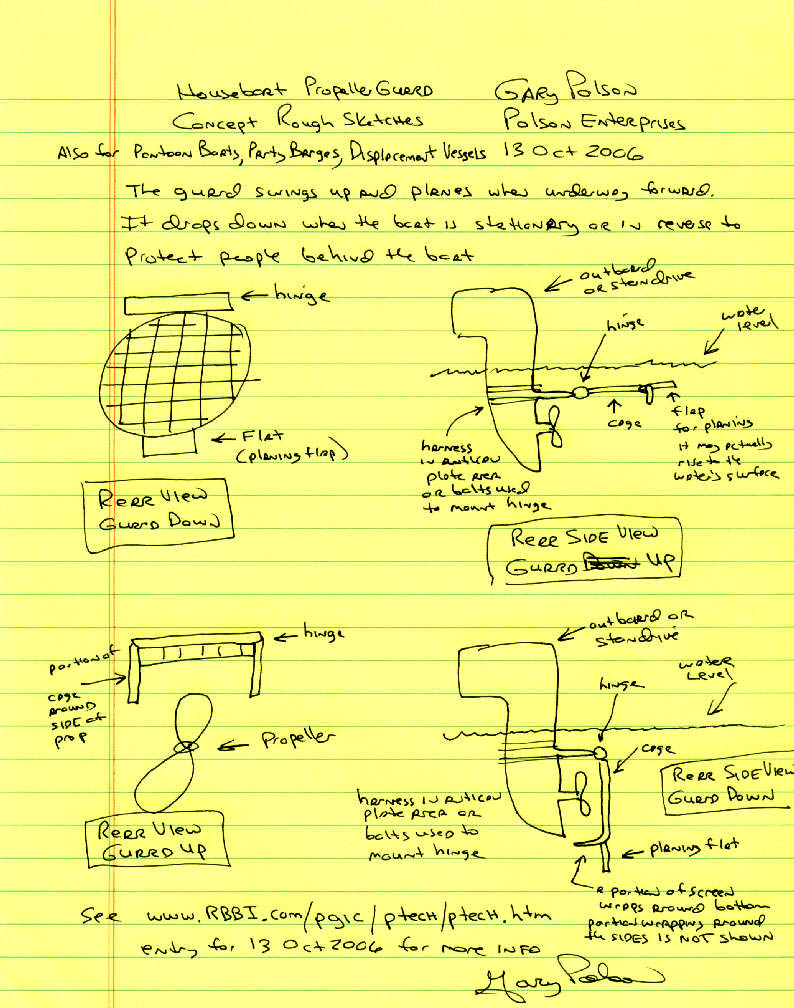
Houseboat Propeller Guard invention
Small display of our rough sketch mentioned above, click on the image to enlarge it. The direct display of this image was added 24 January 2011, however a link to the larger image has been available in the text since it was originally posted.
9 Jan 2007 – Further thoughts on the guard above – a nice round, flat seat could be prepared for the flapping guard to come down against when it is pulled down (back to the toilet example – like a toilet seat comes down against the flat rim of the toilet.) This would provide additional strength and stability to the design.
21 August 2009 – Further thoughts on the guard above – the concept can obviously be applied to a full cage guard. The front portion is attached like normal. The rear screen just flaps up. This provides full protection while going forward and full protection in reverse. When the flapper isis down, it seats against the front portion of the guard, adding stability and strength to the unit when in reverse.
Our old sketch shows the rear screen plus some screens on the side flipping up as together. The principle could be applied only to the rear screen, or to the rear screen plus part or all of the side screen.
The hinge point could be raised (just use a riser near the back of the guard that provides a higher hinge point). This would further decrease drag by allowing the trailing screen to ride even higher in the foam and froth, or on the surface of the water behind the boat when underway.
7 April 2010 – Further thoughts on the guard above – those who do not think the “Flapper” is feasible might wish to review Guy Taylor’s Navigator guard with its 3PO shield (flapper) that was just used in the Brochtrup v. Mercury Marine and Sea Ray Boats case that just won a $3.8 million award from Brunswick. If they are still not convinced of its practicality, they change their views after seeing the Trolling Plates being sold by Cabela’s and countless others. See the photos below.
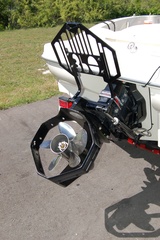
Navigator Prop Guard Up Position
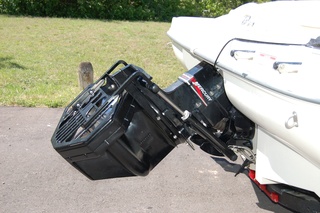
Navigator Prop Guard Down Position
Navigator Propeller Guard with 3PO shield photos from MYFox Austin coverage of the Brochtrup trial.
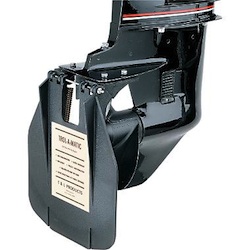
Outboard Motor trolling flap
One of Cabela’s Trolling Plates
21 April 2010 – Continued thoughts on the Flapper Guard – An Internal Flapper Version. Just fill in all or portions of one or more of the lowest rows of cells/mesh at the bottom of the rear screen that swings up (instead of the flapper hanging down below the rear screen, now it occupies the lower cells of the rear screen – it is an Internal Flapper). This way it does not add additional draft (depth requirements) to the unit AND it is located in the squares/cells/area that provides the most leverage against the hinge to allow the rear screen to swing up when underway.
21 April 2010 – Quick History of “Swing Up” or “Flapper” guards. (Last updated 25 January 2011)
21 January 2011 – we noticed Guy Taylor had patent application (U.S. Patent Application US 2011/0009018) recently published for his Boat Propeller Shield. It was filed 9 July 2010 and published 13 January 2011. The patent covers the rear flap for his Navigator 3PO guard. We are happy to see him making efforts in this area, but suspect his patent claims will have some problems with the prior art above. Our posting dates are verifiable via archive.org. Additionally we created another page on flapper propeller guards back on 10 July 2007 (we can prove the date) we are posting today as additional reference material.
24 January 2011 – on closer inspection we note the Guy Taylor patent application we referenced on 21 January is based on a Provisional Patent Application he filed a year earlier on 9 July 2009. His application does bring up a few new potential innovations such as:
While his application may include some new ideas (like those above) the roots of the patent are its two independent claims. Claim 1 basically says he has a “shield” that covers the back of a boat propeller and a connection means that allows that “shield” to pivot over the back of the propeller when the boat is at rest or moving backwards through the water.
His other independent claim, Claim 14, is a method claim. It basically claims the same thing as Claim 1, except it claims the method of doing it instead of the hardware. This means that if a boater was actually using his guard in the water at rest or in reverse, that boater would be infringing on his patent. USPTO often forces applicants wishing to cover both the device and its method to split their patent application into two separate patents, one to cover the device and one to cover the method.
If the first independent claim of his patent is struck down (Claim 1), one thinks that would also remove Claim 14. Then he would either be forced to come up with at least one new independent claim, or abandon his patent application.
Even forgetting our work in this area, in our opinion, Claim 1 has some very serious problems with the first 5 items listed in our Quick History of “Swing Up” or “Flapper Guards” above.
One very basic example of prior art is in an April 11, 2000 letter from PropGuard Inc (now MariTech) to Mike Hahn at Jones Valley Resort. Please see pages 8, 9, 10 (page numbers in top right corner) to see a propeller shield designed for houseboats that covers the back of the propeller with a connection means that allows the “shield” to pivot over the back of the propeller when the boat is at rest or moving in reverse (just like Guy Taylor’s Claim 1). The Jones Valley Resort propeller shield can be seen by clicking on the pdf logo to see the document, then see pages 9, 10, 11. In terms of proving the date (11 April 2000) of that document, it is a Federal Document in a Federal Database (regulations.gov). MariTech’s response was written a couple years later (10 May 2002) in response to a USCG request for public input. MariTech included the Jones Valley sketches and their letter to Mike Hahn as part of their submission. Both documents were written many years before Guy Taylor’s provisional patent application was filed in 2009. A reduced size version of the Jones Valley propeller shield sketch is below.
Jones Valley Flapper Guard April 11, 2000
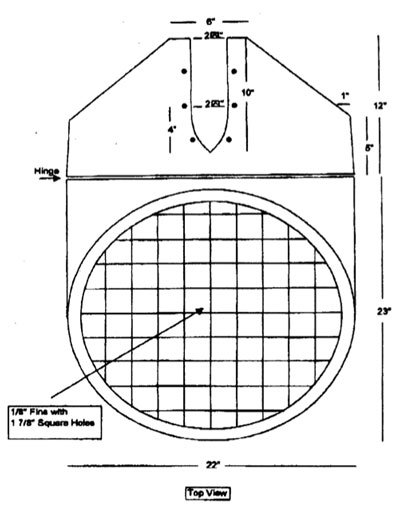
Houseboat Propeller Shield Top View
Top view of propeller shield with shield swung out. Notice the large “V” cutout to allow the base of the shield to lay on top of the anticavitation plate. The “V” cutout goes around the rear of the body of the drive housing (outboard or sterndrive). You can also see the hinge between the two large flat pieces that allows the section with the “screen” in it to swing down when the boat is at rest or in reverse.
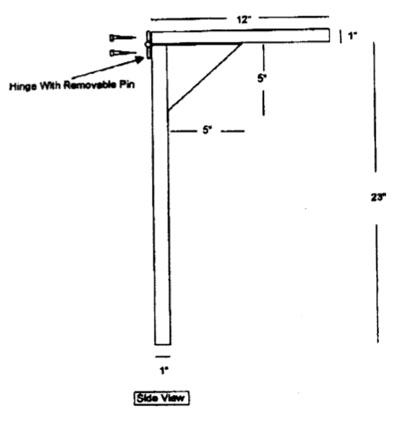
Houseboat Propeller Shield Side View
Side view of propeller shield with shield hanging straight down from the hinge as it would be with the boat at rest or in reverse. The base of the shield is viewed from the edge as it would be laying / bolted down flat on top of the anticavitation plate.
Again, we are thrilled to see Guy Taylor working with a “Flapper”, “Swing Up”, “Shield” or whateveanyone wants to call this approach, however the basic concepts behind this approach are either well defined in previous patents or other prior art. He is free to use those basic concepts as long as he does not infringe on someone else’s patents, but we strongly suspect USPTO will not issue him a patent claim on a basic pivoting shield. However, he may be able to receive a patent on some of his improvements to the prior art.
Additionally, we continue to strongly encourage others to enter this area. “Flapper” type guards can significantly reduce drag and we have yet to see them incorporated in a guard widely available in the marketplace.
31 July 2012 Update on Patent Status of Guy Taylor’s Guard – We used the Public PAIR info on USPTO to followup on his status today. USPTO did cite this flapper propeller guard post with its date of October 13, 2006 in combination to with the Saito (Japanese) patents we referenced above to disallow most of the original claims as made by Mr. Taylor. While it is not uncommon to have many to all claims disallowed and eventually be able to work out something with the USPTO to get your patent issued, these proved to be substantial obstacles. An interview was held in April of 2012 in which the examiner discussed some of the challenges with Mr. Taylor.
Since then, Guy Taylor has made his first patent claim (an independent claim) much more specific in an attempt to get the patent issued. Among the changes are limiting the shield to being a plate with some vents in it (does not cover wire or rod constructed shields), restricting it to plate shields using connecting rods with bends in them, and restricting it to those plate shields that also include a hydroplane member that extends toward the propeller when the shield is down. The new independent claim is much more restrictive. For example his first claim originally was composed of about 65 words. Now it is about 200 words. That makes it much easier for competitors to build relatively similar guards while not infringing on Mr. Taylor’s patent.
It looks like Guy Taylor was issued a notice of allowance in early May 2012 saying that if he paid the required fees within three months (looks like need paid by about August 6, 2012) the patent would be issued with the modified claims.
Guy Taylor will have to make some decisions about the patent application as amended with its new claims. Is the much narrower protection worth the cost? Does the proposed patent still have licensing potential? Can he really sell these against industry opposition? etc.
We wish him well and hope to see his guard with the swing up shield more widely available in the marketplace.
9 September 2012 – Guy Taylor elected to issue U.S. Patent 8,257,121 for a “Boat Propeller Shield”. His patent issued September 4, 2012. We announced the patent on 3PO Navigator Propeller Guard Invented by Guy Taylor Receives Patent.
The same Brunswick patent cites an aircraft patent that might be of interest to some. U.S. Patent #5,074,488 Aircraft Aviation Deactivation Apparatus issued 24 December 1991. The patent describes using infrared sensors to detect people near an aircraft propeller when the plane is on the ground and deactivates the engine. A bypass switch can render the system inoperable if needed.
The sonar head, a ceramic transducer projects a pulse of sound into a sidewall of a coal mine to determine how far it is from parallel tunnels. Due to the difference is sound travel speeds in air and coal, most of the sound is reflected when it hits air on the other side (open space in the other tunnel). The speed of sound in coal is used to determine the distance (thickness of the wall) and then control steering the continuous miner to maintain a constant wall thickness. Perhaps this type of sensing system could be used to reflect sound off human bodies?
Spacecraft conventionally use two thin, spaced aluminum walls for debris impact protection (called a Wipple Shield). Sparsely distributed wires made of shape memory materials could be thermally activated from compact containers to augment Wipple Shields.
Perhaps shape memory materials could be used to jump a guard out into position when it was needed from a stored container? You would only suffer the decreased performance and some of the other issues when it was deployed. If it could not be deployed in time with shape memory materials, perhaps explosives might be used (like an air bag). One would have to be careful not to do “bad things” to boat handling characteristics during and after deployment.
Bistatic Doppler Sonar can be used to detect swimmers in high security areas. The patent identifies frequencies of specific interest to eliminate false alarms. It also talks about using detection logic to decrease false alarms even further.
Cognitive Sensors & Sensor Data Fusion
Many types of sensors might be used to detect people in the water. Some of those will also generate false readings in some situations. For example, if you try to detect body heat, you might also detect a warm boat dock near your boat before you start your engine. If you try to detect motion, a swimmer might be motionless. But tying both sensors together (with possibly even more technologies) and making some decisions based on current parameters (maybe including boat speed, engine RPM, etc) detection could be improved and false signals reduced. Cognitive Sensors and Sensor Data Fusion are techniques being employed in other industries that might lead to solutions in ours. They are briefly described below.
Development of Cognitive Sensors. Nasa Tech Briefs. Vol. 26 No. 4. April 2002 Pg. 22. JPL New Technology Report NPO-30283. Inventors: Ayanna M. Howard and Edward W. Tunstel. Abstract is in printed version of Tech Brief’s. Full paper is online at http://nasatech.com/TSP in the Electronic Components and Systems category.
This paper “Cognitive Sensor Technology” develops the concept of a hierarchy of sensor classes with different levels of intelligence. Sensors are grouped in three levels of increasing intelligence: smart sensors, intelligent sensors, cognitive sensors. The design process for intelligence based sensors is based on five main quantities.
As the authors explored this cognitive sensors, they developed an optical recognition sensor using an imbedded micro controller and a gray scale CCD image sensor mounted on a gimbal platform. The optical recognition sensor responded based on the movement of a transitioning target (it located and tracked moving objects in its view). The intended application was in guiding rovers on space exploration. They discuss using the sensor to detect the safest traversable region for rover navigation based on rock distribution. The micro controller turns the camera to face the safest region and further explore it. An intelligent visual perception algorithm was developed for this application. This same approach might be used in Virtual Propeller Guards to identify people and floating debris near vessels.
Sensor Data Fusion: A Brief Overview. Dr. Gary W. Carriveau. Science Applications International Corporation. 2002.
This introductory level paper talks about using multiple sensor types to detect landmines, a situation not unlike the type of problems encountered trying to detect people in the water.
Really Playing it Safe. an insert in Safety Rules the Road. Design News. 11 Oct 2004.
This article discusses the 2005 Toyota Crown Majesta which introduces a new Vehicle Dynamics Integrated Management system (VDIM) including a pre-crash radar system with both millimeter wave radar and a CCD camera for sensing. Several suppliers are investigating the combination of ranging and vision sensing with complex algorithms, frequently called Sensor Data Fusion, to compensate for the shortcomings in any one particular sensing technology. This technique (Sensor Data Fusion) certainly sounds applicable to sensing people in the water.
Using an array of sensors, including several already present in the Engine Control Module, its not difficult to imagine the system being able to determine what activity you are using the boat for. For example water skiing involves hard acceleration and results in a slower takeoff than would be without pulling a skier (if you sense boat speed and engine RPM and compare it to previous acceleration data you can tell if you are pulling a skier /wake boarder, etc or not. You can even sense when they release or fall off. The sensors could make decisions based on boat activity and the segment of that activity that you are currently in.
Working Together. Consulting Specifying Engineer. Aug. 2004 Pgs. 51-55.
Discusses use of cooperative multi-sensor technologies to detect fires. Different types of sensors reporting values vs. just an alarm are used to make decisions, resulting in fewer false alarms. Photoelectric sensors, ionization sensors and heat sensors are used in unison to make a more accurate decision. A similar process (with different types of sensors) could be used to detect people near a propeller in a virtual propeller guard system.
Fouling the Propeller on Purpose
30 June 2005 entry – We have been promoting the concept of sensing people near the propeller and taking the appropriate action to prevent injury. Today I thought of a new possible action not earlier considered. A canister of compressed plastic mesh, string, “silly string”, instant curing foam, or a combination of similar substances could be directed at the propeller and “fired” when an instant guard is needed (along with shifting the drive to neutral or killing the engine). The propeller would actually “wrap up” itself as it slowed. A large “wad” of resilient material wrapped around the propeller would provide those in the water some level of protection from the blades. A balled up, “rounded” shape might even deflect people that impact the prop and prevent them from squarely impacting it. Some previously proposed actions (inflate airbag near prop) might cause a boat underway to actually capsize or eject more people, while just “fouling” the propeller would seemingly have less impact on the controllability of the boat. It could even help slow the boat by creating additional resistance. Optimally, the substance used to “foul” the propeller would self decompose in water in a few minutes and allow you to get underway normally without requiring someone to remove it from the propeller. The protection is typically only needed for a few seconds. The canister could even be rechargeable and mounted up high on the drive (out of the water) or in the boat and a small tube used to direct it to in front of the propeller (to protect in forward mode only) or also to behind the prop.
Since most “reverse” accidents occur at very slow speeds, just detecting the presence of people and shifting to neutral or killing the engine might be effective. When moving forward at moderate to higher speeds the prop could be “fouled” when needed. The system might even try to wait till the boat slowed down some or make decisions based on the distance to the person and speed of the boat (time til impact).
Wonder if that is something you could shove backwards down the water pickup inside the drive?
“ON THE WATER – Coast Guard Will Cast its Nets Upon the Waters to Corral Suspicious Boats” a 10 Aug 2005 San Francisco Chronicle article reports the Coast Guard is using nets to entangle propellers of boats entering high security areas. “The nets, known as the Mark 11 Static Barrier Running Gear Entanglement System, were the subject of a 320-page environmental review by the Coast Guard.” The nets are made from 1/2 inch thick “Spectra” rope, “a fiber stronger than steel that doesn’t deteriorate in water. As a boat passes over it, the net wraps around the propeller, stopping the vessel.” The article reports the Coast Guard currently fires a similar net at “fleeing vessels to ensnare them”.This product might be used to “foul” the prop on purpose as a prop guard in the manner listed above?
3 Jan 2006 entry – the full 320 page environmental review published in June 2005, discussed above is available from the docket as a 160MB pdf file. It is docket item USCG-2005-21833-2. This document mentions two other systems of this nature. One is the “SeaSpider” a commercially available compressed air launched entranglement device for deployment from a pier, security boat or ship. The second is the “Aerial Compressed Air Net System (A-CANS) RGES, a helicopter launched entanglement system.
3 Jan 2006 entry – Mark 11 Static Barrier Running Gear Entanglement System (RGES). Port Security, Maritime Security, and Homeland Security Blog.
Thursday, December 22, 2005 entry – This blog provides several articles on the Coast Guard’s net fouling system and a great graphic of the system catching an outboard motor. Port Security, Maritime Security, and Homeland Security Blog.
15 Aug 2005 while contemplating other ways to foul the prop today, we encountered a news report in the Roanake Times dated 14 Aug 2005 in which a tow rope “got caught in the propeller and stopped it”, stopping a circling riderless boat after everyone had been ejected. This towrope may have prevented one or more of the four people in the water from being struck by the propeller. We momentarily later encountered another report of perhaps the same accident indicating the driver (a teenage girl) became entangled in the tow rope and was injured by the propeller. The entanglement of the tow rope may have still prevented injuries to others, or perhaps worse injuries to her.
We began to develop the list below of materials that might be used to foul a prop:
We will also soon begin a list of ways those items might be delivered to the prop.
Additional thoughts, it would be best to limit the diameter of the “fouled” prop since a larger diameter would provide a larger cross section and impact more people? Their might be a tradeoff in slowing, stopping rotation, “padding the prop” and size?
19 Aug 2005 Fed BizOpps reported a proposal request for “Portable Entanglement Net” as a combined solicitation (from U.S. Coast Guard and related agencies) dated 18 August 2005. It included reports they have “developed various devices to entangle the propellers of small outboard or inboard/outboard (IO) powered craft (length over all up to 40 feet, total power up to 675 HP using one or more outboard or I/O engines) that do not comply with orders to stop.” The system called “Running Gear Entanglement System” (RGES) consists of a header-line with U-shaped loops of rope suspended below it. They alos have an existing It has been proven effective, but must be deployed by dragging it in front of the vessel to be stopped. There is also an existing MK 10 version that can be fired from a canister on a Coast Guard vessel (shot out in front of the fleeing vessel). The request for proposal is for a more portable system that can be hand-fired and reloaded quickly and used from small craft such as CG rigid hull inflatables, port security boats or utility boats (UTBs). They report the “USCG has found that it’s relatively easy to fire a net into the water such that the net affixes itself to the lower unit. The difficulty has been in getting the net to entangle the vessel’s propeller blades.”